
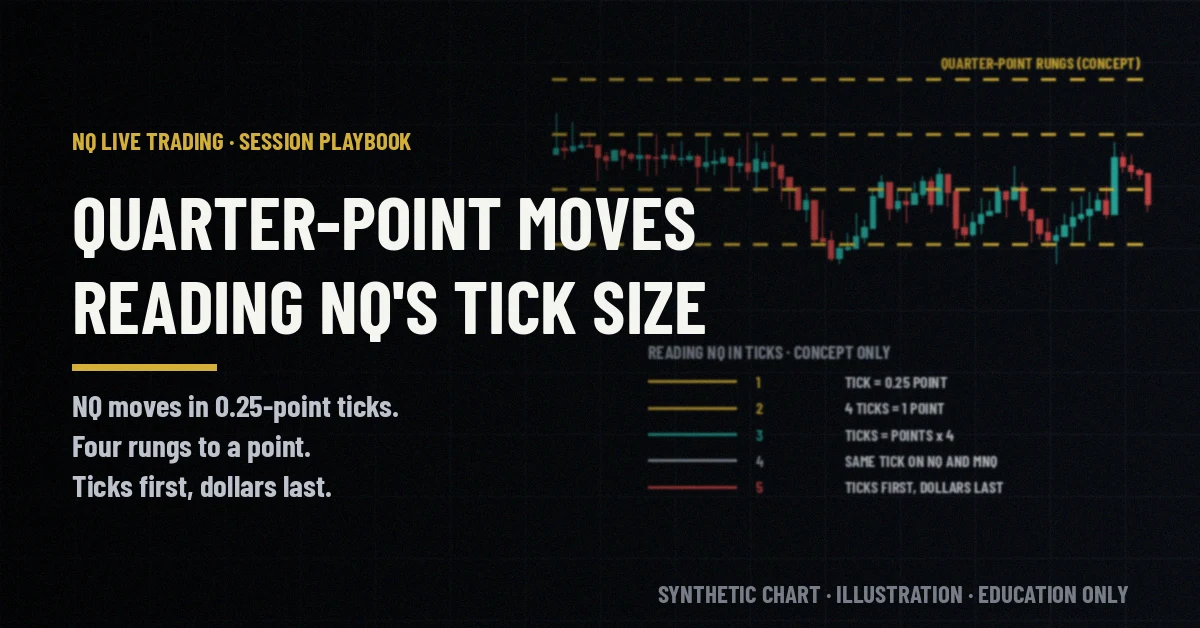
Quarter-Point Moves: Reading NQ’s Tick Size
By CK · Futures trader since 1998
Short answer: NQ’s tick size is 0.25 index points. Price can only move in quarter points, so every quote ends in .00, .25, .50 or .75, and there are four ticks in every point (CME NQ specs). MNQ uses the same 0.25-point tick (CME MNQ specs). In the live room, we count distance in ticks and points before we ever talk dollars.
Education only. Futures trading involves substantial risk of loss. Not financial advice.
Four numbers on every quote
Watch the NQ price ladder for one minute and you’ll notice something odd.
The last two digits never say .10. They never say .37. They only ever say four things: .00, .25, .50, .75.
Then the next point. Then the same four again.
That’s not a quirk of your platform. It’s the contract. And once you see the market in those four steps, a lot of confusing things get simpler: why your stop filled where it did, why “10 points” and “40 ticks” are the same thing, and why the room keeps saying “ticks” when you’re thinking “dollars.”
Have you ever mixed up points and ticks?
How many traders set a “10-tick stop” when they meant 10 points, and ended up with a stop one quarter the size they planned?
How many traders read a level as “up 3” without knowing if that was three points or three ticks?
And how many traders put an order at a price NQ can’t even trade, then wondered why the platform rounded it?
None of those are strategy problems. They’re reading problems, and they get solved with a few minutes of arithmetic.
What is NQ’s tick size?
The minimum price fluctuation for E-mini Nasdaq-100 futures (NQ) is 0.25 index points, worth $5.00 per contract (CME NQ specs). “Tick” is the everyday name for that minimum move. One full point is four ticks.
The Micro E-mini Nasdaq-100 (MNQ) has the same 0.25-point minimum fluctuation, but each tick is worth $0.50, one tenth of NQ (CME MNQ specs). Same ladder, smaller contract.
| NQ | MNQ | |
|---|---|---|
| Tick size | 0.25 index points | 0.25 index points |
| Ticks per point | 4 | 4 |
| Value of one tick | $5.00 | $0.50 |
| Value of one point | $20.00 | $2.00 |
Source: CME contract specifications, linked above. For the dollar side of this table, see what one tick and one point are worth on NQ, or run your own numbers in the NQ tick value calculator. CK Trader Pro’s NQ contract specs guide covers the rest of the contract.
How do you read the NQ ladder in quarter points?
Read each point as four rungs: .00, .25, .50, .75. Every rung up or down is one tick. Here’s a hypothetical ladder around a made-up level, not a real quote:
| Hypothetical price | Ticks above the .00 level | Points above |
|---|---|---|
| 20,001.00 | 4 | 1.00 |
| 20,000.75 | 3 | 0.75 |
| 20,000.50 | 2 | 0.50 |
| 20,000.25 | 1 | 0.25 |
| 20,000.00 | 0 | 0.00 |
That’s it. No in-between prices exist on the contract. If a level on your chart sits at a value that isn’t a quarter point, the order you place there will be at the nearest valid tick, not the line itself.
How many ticks are between two levels?
Subtract the two prices to get points, then multiply by four to get ticks. That’s the whole formula: ticks = points × 4.
| Distance in points | Ticks | Where it shows up for us |
|---|---|---|
| 0.25 | 1 | The smallest possible move |
| 1 | 4 | “One handle,” as many traders call a full point |
| 2.5 | 10 | A “10-tick” move, which is only 2.5 points |
| 10 | 40 | A move many traders would call “10 points” |
| 25 | 100 | A distance worth writing down before the open |
In my experience, the “10 ticks versus 10 points” mix-up is one of the most common sizing mistakes new NQ traders make. Ten points is four times bigger than ten ticks. Say which one you mean, every time.
Why do we write stops and targets in ticks?
Because ticks are the same on every contract size, and the dollars aren’t. A stop that’s 40 ticks away is 40 ticks on NQ and 40 ticks on MNQ. The risk in dollars depends on how many contracts and which one, and that’s a separate step.
So in the room, the order is always the same:
- Find the level. Where does structure say the idea is wrong? (See where to place your stop on NQ.)
- Count the distance. Points from entry to that level, times four, equals ticks.
- Then size it. Ticks × tick value × contracts gives the dollar risk. Our NQ vs MNQ sizing post walks through it, and CK Trader Pro’s position sizing calculator guide does the math for you.
Here’s a hypothetical example, contract math only, before commissions and fees: a stop 12 points away is 48 ticks. On 1 NQ that’s 48 × $5 = $240. On 1 MNQ it’s 48 × $0.50 = $24. Same distance, same ticks, very different dollars. Stops are not guaranteed to fill at your price, and no stop guarantees a maximum loss. In a fast market a stop-market order can fill several ticks past your stop.
Here’s the big idea
The tick is the market’s unit of measure. Learn to think in it, and everything else is multiplication.
Points tell you distance. Ticks tell you distance in the contract’s own steps. Dollars come last, after you’ve chosen the contract and the size.
What changes when NQ moves fast?
The ticks stay the same size, but more of them go by in each second. On a scheduled release like the 8:30 AM ET CPI morning, price can skip through many quarter-point rungs quickly. That’s why the extra few ticks of slippage matter: each one is still $5 on NQ or $0.50 on MNQ.
We plan for that by counting ticks before the open, not during the move. The levels we mark in our premarket routine get a distance in points and ticks written next to them, so nobody’s doing arithmetic while the ladder is flying.
Here’s the point
NQ only moves in quarter points. Four ticks make a point. Count the distance in ticks first, size it second, and say “ticks” or “points” out loud so you never confuse the two.
Remember this
Four rungs to a point. Ticks first, dollars last.
So here’s my question: the next time you set a stop, will you know how many ticks away it is before you click?
Watch it live
Join this week’s room. We meet Monday through Friday, 9:30 to 10:30 AM ET, with the morning’s levels on the screen and the distance between them written in points and ticks. There’s no cost to attend. Join the free live room and count the ladder with us. New here? Read how the free live room works.
Registration is required. Adults 21+. Sessions are education, not signals.
The room is the free education arm of CK Trader Pro.
Join the Academy
Want the structure behind the morning? CK Trader Pro is futures and prop firm education: step-by-step lessons, live sessions and risk planning. It’s the CK Trader Pro Membership, which includes:
- Members-only educational lessons on prop-firm rules, drawdown, daily loss limits, position sizing and risk
- War Room: CK’s live pre-market planning session, weekdays 8:30–9:30 AM ET, where the day’s risk and news times get written down before the open
- CK’s chart setup, shown and explained live in every session
- Economic news calendar
Education only. No trade signals or personal advice. No results promised.
Billed monthly until you cancel. See pricing at cktraderpro.com.
The live room stays free either way.
FAQ
What is the tick size on NQ futures? NQ’s minimum price fluctuation is 0.25 index points, worth $5.00 per contract, per CME’s contract specifications. Prices move only in quarter points: .00, .25, .50 and .75.
How many ticks are in one NQ point? Four. Each tick is 0.25 points, so one full point is four ticks. To convert, multiply points by four.
Is MNQ’s tick size the same as NQ’s? Yes. MNQ also moves in 0.25-point ticks, but each tick is worth $0.50 instead of $5.00, per CME’s contract specifications.
Is a 10-tick stop the same as a 10-point stop? No. Ten ticks is 2.5 points. Ten points is 40 ticks, four times larger. Always say which unit you mean.
Why does my platform round my order price? NQ can only trade at quarter-point prices, so an order price must sit on a valid tick. Check how your platform handles a price that isn’t a valid tick before you rely on it.
Do stops on NQ guarantee my maximum loss? No. Stops are not guaranteed to fill at your price, and no stop guarantees a maximum loss. In a fast market a stop-market order can fill several ticks past your stop.
About CK
CK (George Ama) is a futures trader since 1998 and the founder of CK Trader Pro. He is the author of The Risk First Series, including Risk First: The NQ Futures Playbook and Risk First: Execution.
Trading futures involves substantial risk of loss and is not suitable for everyone. Past performance is not indicative of future results. Education only, not financial advice. The live room is for adults 21+. Example numbers in this article are hypothetical contract math, not predictions or recommendations. No stop guarantees a maximum loss; stops are not guaranteed to fill at your price. CK Trader Pro and NQ Live Trading aren’t owned, run or endorsed by any prop firm. See our Risk Disclosure, CK Trader Pro’s Risk Disclosure and Disclosures. NQ Live Trading and CK Trader Pro are operated by CK TRADING INSTITUTE OF TECHNOLOGY LLC.