
NQ Premarket Levels We Mark Before the 9:30 Open
By CK · Futures trader since 1998
Short answer: Before the 9:30 AM ET U.S. stock market open, we mark a short list of NQ premarket levels: the prior day’s high and low, the prior day’s close or settlement, the overnight high and low, and the size of any gap from that close. Each one is a reference point to watch at the open, not a signal to trade.
Education only. Futures trading involves substantial risk of loss. Not financial advice.
The chart with forty lines
Open a chart at 9:25 AM ET and count the lines on it.
Some traders have three. Some have forty: every old high, every round number, every level someone mentioned in a chat. When the open hits and price starts moving, the trader with forty lines has a line next to every candle, and so every candle looks important.
That’s the problem with levels. Each one feels useful when you draw it. Together, they can hide the few that matter.
Have you ever noticed this before the open?
How many traders draw a level at 9:00, then can’t remember at 9:35 why it’s there?
How many traders treat “the close” as one number, when NQ has more than one reasonable close?
And how many traders measure a gap by eye, then size a trade without knowing how many points it actually is?
None of those are market problems. They’re labeling problems, and they get solved before 9:30.
What are NQ premarket levels?
NQ premarket levels are the reference prices you mark before the 9:30 AM ET stock market open, built from the prior day and the overnight session. NQ trades nearly around the clock on CME Globex, Sunday to Friday, 6:00 PM to 5:00 PM ET, with a daily break from 5:00 to 6:00 PM ET (CME Group trading hours).
One point many traders mix up: 9:30 AM ET isn’t when NQ opens. It’s when the U.S. stock market opens (NYSE hours and calendars). By then, NQ has usually been trading since 6:00 PM ET the evening before. So “premarket” here means the stretch before the cash open, not before the futures open. CK Trader Pro’s guide to NQ futures trading hours and rollover covers the full schedule.
Which levels do we mark before 9:30 AM ET?
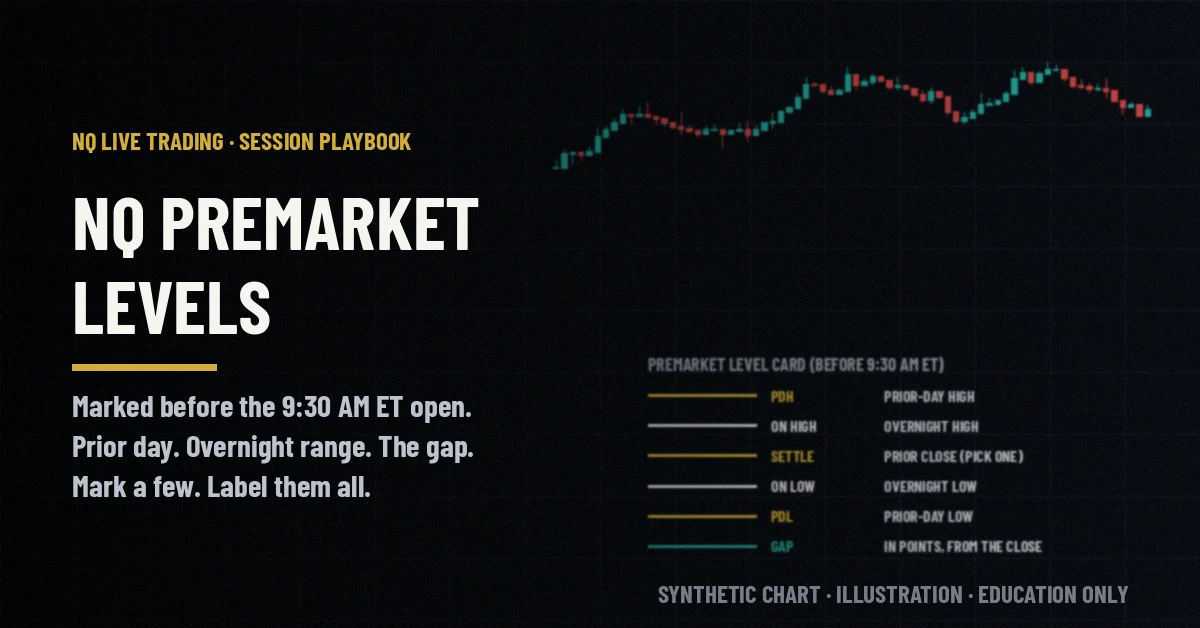
A short list, the same every day: prior-day high, prior-day low, prior-day close or settlement, overnight high, overnight low, and the gap between the prior close and where NQ is trading before the open. Some traders add the overnight open and one or two higher-timeframe zones. Each level gets a label, so you know why it’s there.
| Level | Where it comes from | Why it’s on the card | Go deeper |
|---|---|---|---|
| Prior-day high | Highest price of the previous session | Shows where buyers ran out of room yesterday | Prior-day high and low |
| Prior-day low | Lowest price of the previous session | Shows where sellers ran out of room yesterday | Same post |
| Prior-day close or settlement | The reference price you choose (see below) | The anchor for measuring any gap | Next section |
| Overnight high | Highest price from 6:00 PM ET to the 9:30 AM ET cash open | The top of the range NQ built while stocks were closed | the overnight high and low |
| Overnight low | Lowest price over the same window | The bottom of that range | the overnight high and low |
| Gap from the prior close | Pre-open price minus the prior close, in points | Tells you if the open starts inside or outside yesterday’s range | Monday gap |
| Optional: overnight open | First price after the 6:00 PM ET Globex reopen | One more anchor for the overnight session | n/a |
On Mondays, “prior day” means Friday, and the overnight session starts Sunday at 6:00 PM ET. That’s why Monday gets its own gap post.
Here’s the big idea
A level is a question, not an answer.
When NQ reaches the prior-day high, the level doesn’t tell you to buy or sell. It asks you something: is price being accepted above it, or rejected? Your premarket levels are a list of questions you’ve written down in advance, so the open doesn’t have to invent them for you.
Which “close” should you use for NQ?
Pick one definition, write it on your card and use it every day. NQ has at least three reasonable “closes”: CME’s official daily settlement price, the price at the 4:00 PM ET stock market close, and the last trade before the 5:00 PM ET Globex break. They can differ, and a gap measured from one won’t match a gap measured from another.
Here’s the short version:
- Daily settlement. CME publishes an official settlement price for each contract every trading day, based on trading near 4:00 PM ET under CME’s settlement procedure (CME E-mini Nasdaq-100 settlements). It’s usually close to, but not always the same as, the 4:00 PM ET price. Some charting platforms can show it.
- 4:00 PM ET. The U.S. stock market’s regular session ends at 4:00 PM ET (NYSE hours and calendars). Some traders use NQ’s price at that moment to line up with the cash index.
- Last trade before 5:00 PM ET. The final print before the daily Globex break.
In my experience, which one you choose matters less than using the same one every day. Switching definitions mid-week is how a “gap” appears that was never there.
How do you measure the gap in points and ticks?
Subtract the prior close from the price before the open. That’s the gap in points. Multiply by four for ticks, because NQ’s minimum tick is 0.25 index points. NQ moves $5 per tick, or $20 per point. MNQ moves $0.50 per tick, or $2 per point (CME NQ specs; CME MNQ specs).
Here’s a hypothetical example, contract math only:
| Hypothetical gap | Ticks | Price movement, 1 NQ | Price movement, 1 MNQ |
|---|---|---|---|
| 10 points | 40 | $200 | $20 |
| 25 points | 100 | $500 | $50 |
| 40 points | 160 | $800 | $80 |
These numbers describe the size of a move, not a prediction of the next one. Run your own in the NQ tick value calculator, or see what one tick and one point are worth.
How many premarket levels is too many?
In my experience, if you can’t say out loud why a level is on your chart, it shouldn’t be there. The list above is six levels, plus one optional. On many mornings, that’s enough to frame the open. Adding a seventh or eighth line rarely adds clarity; more often, it adds hesitation.
A simple test before 9:30 AM ET:
- Label every line. “PDH,” “PDL,” “SETTLE,” “ON HIGH,” “ON LOW.” No unlabeled lines.
- Write the gap in points. One number, measured from the close you chose.
- Note where price sits. Inside yesterday’s range, above the prior-day high or below the prior-day low.
- Check the clock. Any 8:30 or 10:00 AM ET reports today? Our economic calendar guide covers that step.
- Erase the rest. If a line didn’t make the list, it doesn’t stay on the chart.
That’s a reference card, not a full plan. For the full morning routine (risk, scenarios and a “no trade” rule), see our simple pre-market plan for NQ, and CK Trader Pro’s guide to pre-market futures analysis.
What happens to these levels at 9:30?
At 9:30 AM ET they become the map we read the open against. We don’t act on them the moment the bell rings. We watch where the first minutes form relative to the levels, then read the opening range before leaning on any idea. A level is a place to watch, not a guaranteed turning point or a stop.
Two posts go deeper on that part: reading the NQ opening range in the first 30 minutes and patience at the 9:30 cash open. CK Trader Pro’s opening range guide covers the education side.
If you ever use a level to place a stop, remember: a stop-market order becomes a market order when it triggers, so it can fill past your stop price. A stop-limit may not fill at all. Check how your platform handles stops. Stops are not guaranteed to fill at your price, and no stop guarantees a maximum loss.
Here’s the point
Premarket levels don’t tell you what NQ will do. They tell you where you’ll be paying attention, and why, before the open gets loud.
Remember this
Mark a few. Label them all. Measure the gap in points.
So here’s my question: if you looked at your chart at 9:29 tomorrow, could you explain every line on it in one sentence?
Watch it live
See the levels on the chart before the open. We meet Monday through Friday, 9:30 to 10:30 AM ET, with the morning’s levels already on the screen, and talk through how NQ treats them as the open forms. There’s no cost to attend. Join the free live room and compare your card with ours.
Registration is required. Adults 21+. Sessions are education, not signals.
The room is the free education arm of CK Trader Pro.
Join the Academy
Want the structure behind the morning? CK Trader Pro is futures and prop firm education: step-by-step lessons, live sessions and risk planning. It’s the CK Trader Pro Membership, which includes:
- Members-only educational lessons on prop-firm rules, drawdown, daily loss limits, position sizing and risk
- War Room: CK’s live pre-market planning session, weekdays 8:30–9:30 AM ET, where the day’s risk and news times get written down before the open
- CK’s chart setup, shown and explained live in every session
- Economic news calendar
Education only. No trade signals or personal advice. No results promised.
Billed monthly until you cancel. See pricing at cktraderpro.com.
The live room stays free either way.
FAQ
What premarket levels should I mark on NQ? A short list: prior-day high, prior-day low, prior-day close or settlement, overnight high and low, and the gap from the prior close in points. Label each one so you know why it’s on the chart.
Does NQ open at 9:30 AM ET? No. NQ trades on CME Globex Sunday to Friday, 6:00 PM to 5:00 PM ET, with a daily 5:00–6:00 PM ET break. 9:30 AM ET is the U.S. stock market open.
What counts as the overnight session on NQ? In this post, it’s the trading from the 6:00 PM ET Globex reopen to the 9:30 AM ET stock market open. On Mondays, it starts Sunday at 6:00 PM ET.
Which close should I use to measure the NQ gap? Pick one: CME’s daily settlement, the price at the 4:00 PM ET stock market close, or the last trade before the 5:00 PM ET break. Use the same one every day so your gaps are comparable.
How much is a 10-point move on NQ? NQ is $20 per point, so 10 points is $200 per NQ contract and 40 ticks. MNQ is $2 per point, so 10 points is $20 per MNQ contract.
About CK
CK (George Ama) is a futures trader since 1998 and the founder of CK Trader Pro. He is the author of The Risk First Series, including Risk First: The NQ Futures Playbook and Risk First: Execution.
Trading futures involves substantial risk of loss and is not suitable for everyone. Past performance is not indicative of future results. Education only, not financial advice. The live room is for adults 21+. Example numbers in this article are hypothetical contract math, not predictions or recommendations. No stop guarantees a maximum loss; stops are not guaranteed to fill at your price. CK Trader Pro and NQ Live Trading aren’t owned, run or endorsed by any prop firm. See our Risk Disclosure, CK Trader Pro’s Risk Disclosure and Disclosures. NQ Live Trading and CK Trader Pro are operated by CK TRADING INSTITUTE OF TECHNOLOGY LLC.