
NQ on CPI Mornings: What Changes at 8:30 AM ET
By CK · Futures trader since 1998
Short answer: On CPI day, the U.S. Bureau of Labor Statistics releases the Consumer Price Index at 8:30 AM ET, an hour before the 9:30 AM ET U.S. stock market open, while NQ is already trading. We don’t trade the release. We write down our levels and risk before 8:30, let the inflation number land, and read what NQ did with it before we decide anything at the open.
Education only. Futures trading involves substantial risk of loss. Not financial advice.
The quiet minute before the number
It’s 8:29 AM ET on a weekday in the middle of the month. NQ has drifted all night. The chat is slow.
Then the clock hits 8:30, and one inflation number lands on every screen at the same moment.
Some traders already have an order resting, hoping to catch the move. Some click the moment a candle stretches. And some just watch, because they wrote down the night before that the first minutes after CPI aren’t theirs.
This post is about being that third trader on a CPI morning, and why that’s a plan, not a lack of one.
Have you ever done this on CPI day?
How many traders know “CPI is this week,” but couldn’t tell you which day or what time?
How many traders mark their levels at 9:20, after the release already pushed price through half of them?
And how many traders size the open like any other morning, on a day that started with a scheduled shock?
None of those are prediction problems. They’re preparation problems, and they get solved before 8:30.
What is the CPI report?
The Consumer Price Index is the BLS measure of the average change over time in the prices paid by urban consumers for a market basket of consumer goods and services (BLS CPI home). Traders call it “the inflation report” or just “CPI.”
Two lines from the release tend to get the most attention:
- The headline (all items). BLS reports the index for all urban consumers, month over month (seasonally adjusted) and over the year (not seasonally adjusted) (BLS CPI home).
- “Core” (all items less food and energy). BLS publishes this index in the same release. Traders call it “core CPI.”
We don’t quote this month’s numbers here, and we won’t guess the next one. What matters for the morning is the minute it arrives.
When is the next CPI report?
The November 2026 CPI is scheduled for Thursday, December 10, 2026, at 8:30 AM ET, per the BLS CPI release schedule (checked November 10, 2026). Release dates can change, so check the BLS page the week of.
Notice the pattern: CPI doesn’t sit on one fixed weekday the way the jobs report usually lands on a Friday. It moves around the middle of the month. That’s one reason it surprises people. Our economic calendar guide shows how to put release times on your card before the week starts.
Why does 8:30 matter for NQ?
Because NQ is open when the number lands. NQ trades on CME Globex Sunday to Friday, 6:00 PM to 5:00 PM ET, with a daily break from 5:00 to 6:00 PM ET (CME NQ specifications). These are normal hours; holidays and trading halts can change them. The 9:30 AM ET open is the U.S. stock market’s open, not NQ’s (NYSE hours and calendars).
So the reaction to CPI starts in futures an hour before stocks open. By 9:30, NQ may be trading far from where it sat at 8:29, and the levels you marked the night before can look very different.
Is NQ more volatile on CPI day?
Sometimes the move after 8:30 is fast, and sometimes it’s barely noticeable. We don’t publish a CPI volatility statistic, because we haven’t found a published study we’d stand behind. In my experience, the honest answer to “how far will NQ move on CPI?” is “you don’t know, and you don’t need to.”
What you can control is your exposure to that minute. That’s the whole playbook.
Here’s the big idea
CPI is a known unknown. You can’t know the number, but you can know the minute.
That’s the advantage. On a normal morning, surprises show up without warning. On CPI day, the biggest one is on the calendar with a timestamp. You get to decide, in advance and in writing, what you’ll do before it, during it and after it.
How do we plan a CPI morning?
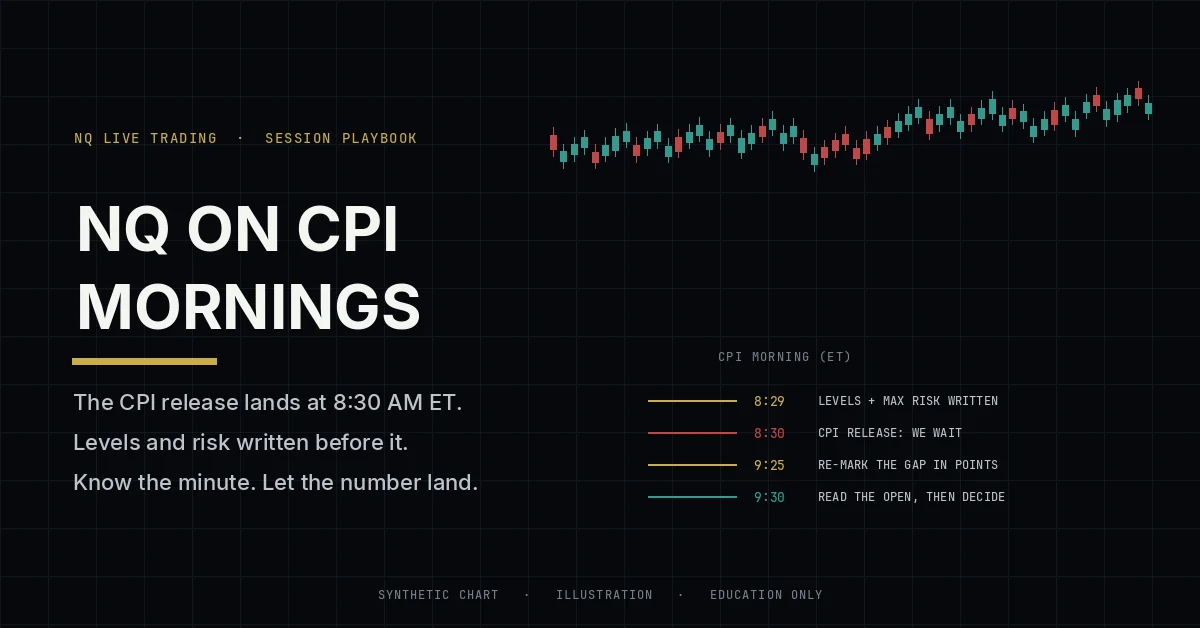
We plan it in three windows: before 8:30, 8:30 to 9:30, and the open. Each window has one job.
| Window (ET) | What we do | What we don’t do |
|---|---|---|
| Before 8:30 AM | Mark prior-day high and low, the overnight range and our chosen close. Write the day’s max risk. Note any other reports scheduled that morning. | Rest an order that sits in the path of the release. |
| 8:30 to 9:30 AM | Watch where NQ goes after the number. Re-mark the gap from the prior close in points. Note which levels price ran through. | Chase the first candle. |
| 9:30 AM open | Read the opening range against the updated levels, then decide whether there’s a trade at all. | Assume the 8:30 direction continues. |
If that table looks familiar, it should. It’s the same three-window plan we use on jobs report Fridays. The release changes. The process doesn’t. The “before” column is the list in the NQ premarket levels we mark before 9:30.
In my experience, the most useful line on a CPI morning is the one you write at 9:25: “Here’s where we are versus yesterday’s range, and here’s how many points the gap is now.”
What about stops and slippage at 8:30?
Fast markets can fill orders far from the price you expected. If you hold a position into 8:30 or leave a stop working, know how your order type behaves. A stop-market order becomes a market order when it triggers, so it can fill past your stop price. A stop-limit may not fill at all. Stops are not guaranteed to fill at your price, and no stop guarantees a maximum loss. Where the stop goes in the first place is a structure question; see where to place your stop on NQ.
Here’s a hypothetical example, contract math only. NQ is $5 per 0.25-point tick, or $20 per point; MNQ is $0.50 per tick, or $2 per point (CME NQ specs; CME MNQ specs).
| Hypothetical fill past your stop | Ticks | Extra cost, 1 NQ | Extra cost, 1 MNQ |
|---|---|---|---|
| 2 points | 8 | $40 | $4 |
| 5 points | 20 | $100 | $10 |
| 10 points | 40 | $200 | $20 |
These are sizes of a hypothetical fill, before commissions and fees, not a forecast of slippage on any CPI morning. Run your own numbers in the NQ tick value calculator. That math is the reason we’d rather be flat at 8:30 than guess.
If you trade with a drawdown limit, one fast morning can use up more of it than you planned. CK Trader Pro’s guide to drawdown management covers how to plan for that before the week starts.
Is sitting out a trading decision?
Yes. Choosing not to trade a window is a decision, and you can make it before the morning starts. It’s easy to treat “no trade” as a failure. We treat it as a rule with a time attached.
The same logic runs through every scheduled event. We plan Fed afternoons the same way in trading NQ on FOMC day. When CPI and a Fed decision fall in the same week, both go on the card, each with its own time and its own risk line.
What changes at the 9:30 open on CPI day?
The open is still the open. We just read it against a map that moved. We let the first minutes form, then read the opening range before leaning on any idea. The difference on CPI day is that the gap may be larger and the overnight range may be stretched by the 8:30 move, so the levels from the night before need a second look.
For the method, see reading the NQ opening range in the first 30 minutes and prior-day high and low as your first map.
Here’s the point
You don’t need to guess the CPI number. You need to know the minute it arrives, have your levels and risk written before it, and let the open show you what the number meant.
Remember this
Know the minute. Write it down first. Let the number land.
So here’s my question: on the next CPI morning at 8:29 AM ET, what will be written on your card?
Watch it live
Join before the next CPI morning. We meet Monday through Friday, 9:30 to 10:30 AM ET, with the morning’s levels on the screen and the 8:30 move already marked, and we talk through how NQ treats them as the open forms. There’s no cost to attend. Join the free live room and watch a CPI morning open with us.
Registration is required. Adults 21+. Sessions are education, not signals.
The room is the free education arm of CK Trader Pro.
Join the Academy
Want the structure behind the morning? CK Trader Pro is futures and prop firm education: step-by-step lessons, live sessions and risk planning. It’s the CK Trader Pro Membership, which includes:
- Members-only educational lessons on prop-firm rules, drawdown, daily loss limits, position sizing and risk
- War Room: CK’s live pre-market planning session, weekdays 8:30–9:30 AM ET, where the day’s risk and news times get written down before the open
- CK’s chart setup, shown and explained live in every session
- Economic news calendar
Education only. No trade signals or personal advice. No results promised.
Billed monthly until you cancel. See pricing at cktraderpro.com.
The live room stays free either way.
FAQ
What time is the CPI report released? The BLS Consumer Price Index is released at 8:30 AM ET, one hour before the 9:30 AM ET U.S. stock market open. Check the BLS CPI release schedule for each month’s date.
Is NQ trading when CPI comes out? Yes. NQ trades on CME Globex Sunday to Friday, 6:00 PM to 5:00 PM ET, with a daily 5:00–6:00 PM ET break, so it’s normally open at 8:30 AM ET. Holidays and trading halts can change that.
What is core CPI? “Core CPI” is the common name for the BLS index for all items less food and energy, published in the same release as the headline all-items index.
Is NQ more volatile on CPI day? It can move fast after 8:30, but we don’t quote a CPI volatility statistic because we haven’t found a published study we’d stand behind. We plan the morning around the release time instead of a forecast.
Should I hold a stop through the 8:30 CPI release? That’s your decision. Know that fast markets can fill a stop-market order past your stop price, and a stop-limit may not fill at all. No stop guarantees a maximum loss.
About CK
CK (George Ama) is a futures trader since 1998 and the founder of CK Trader Pro. He is the author of The Risk First Series, including Risk First: The NQ Futures Playbook and Risk First: Execution.
Trading futures involves substantial risk of loss and is not suitable for everyone. Past performance is not indicative of future results. Education only, not financial advice. The live room is for adults 21+. Example numbers in this article are hypothetical contract math, not predictions or recommendations. No stop guarantees a maximum loss; stops are not guaranteed to fill at your price. CK Trader Pro and NQ Live Trading aren’t owned, run or endorsed by any prop firm. See our Risk Disclosure, CK Trader Pro’s Risk Disclosure and Disclosures. NQ Live Trading and CK Trader Pro are operated by CK TRADING INSTITUTE OF TECHNOLOGY LLC.