
Market vs Limit Orders on NQ: Slippage in Plain Numbers
By CK · Futures trader since 1998
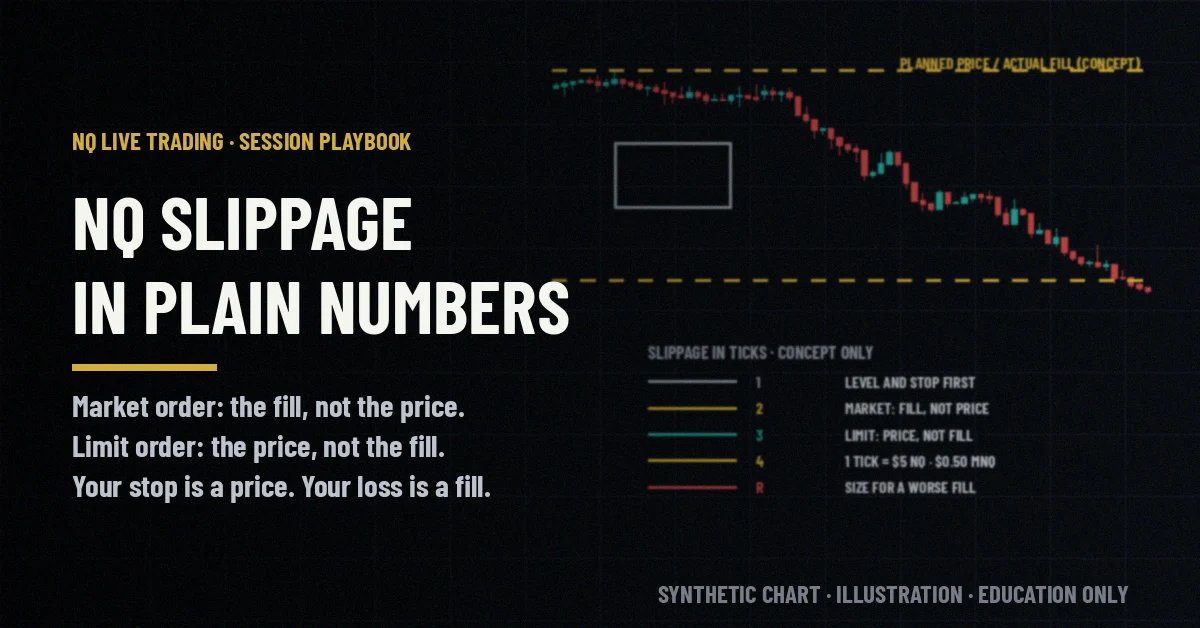
Short answer: Slippage is the difference between the price you expected and the price you got. On NQ, prices move in 0.25-point ticks, so one tick of slippage is $5 per NQ contract and $0.50 per MNQ contract. A market order gets you filled but doesn’t promise the price. A limit order promises the price or better but doesn’t promise a fill.
Education only. Futures trading involves substantial risk of loss. Not financial advice.
The fill that wasn’t your price
You see the level. You click buy. The order fills.
Then you look at the fill price, and it’s not the price you saw. It’s a tick higher. Sometimes two. On a fast morning, more.
Nobody stole anything from you. The market moved between the moment you decided and the moment your order met a seller. That gap has a name: slippage. And here’s the part many traders never do. They never put a number on it.
So let’s put a number on it. Because once you can say what one tick costs you, in dollars, per contract, slippage stops being a feeling and becomes part of your plan.
Have you ever done this?
How many traders have hit a market order into a fast candle and wondered why the fill was worse than the chart?
How many traders have parked a limit order one tick away, watched price come within a hair of it, and then watched the move leave without them?
And how many traders have sized a trade to the exact dollar they could afford to lose, with zero room for a worse fill on the way out?
None of those are bad luck. They’re order-choice problems. And the fix starts with knowing what each order type promises, and what it doesn’t.
What is slippage on NQ futures?
Slippage is the difference between the price you expected when you sent an order and the price it actually filled at. On NQ, it’s counted in ticks. One tick is 0.25 index points, worth $5 on one NQ contract and $0.50 on one MNQ contract (CME Group E-mini Nasdaq-100 contract specifications; Micro E-mini Nasdaq-100 contract specifications).
Slippage can go against you or, sometimes, in your favor. What we care about in the room is the cost side, because that’s the side that eats into your planned risk.
If ticks and points still trip you up, start with Quarter-Point Moves: Reading NQ’s Tick Size. Four ticks make one point. One point is $20 on NQ and $2 on MNQ.
What’s the difference between a market order and a limit order?
A market order asks to buy or sell right away at the best price available. It’s built to get filled, but it doesn’t guarantee the price. A limit order asks to buy or sell at your price or better. It controls the price, but it doesn’t guarantee a fill. That’s the trade-off: certainty of fill vs. certainty of price.
Investor.gov, the SEC’s investor education site, describes these order types for stocks this way: a market order “guarantees that the order will be executed, but does not guarantee the execution price,” and “the last-traded price is not necessarily the price at which a market order will be executed.” A buy limit “can only be executed at the limit price or lower,” and a sell limit “at the limit price or higher” (Investor.gov, Types of Orders). Those are general securities definitions, not futures rules; the same fill-versus-price trade-off applies to futures orders.
| Market order | Limit order | |
|---|---|---|
| What it promises | A fill (when there’s a market to trade against) | Your price or better, if it fills |
| What it doesn’t promise | The price | A fill at all |
| Where slippage shows up | In the fill price | Not in price, but in missed or partial fills |
| The risk you’re accepting | Paying more ticks than you planned | Missing the trade, or getting only part of it |
Neither one is “the right order.” Each one is a choice about which risk you’d rather carry on that trade.
How much does slippage cost on NQ and MNQ?
Multiply the ticks of slippage by $5 for each NQ contract or $0.50 for each MNQ contract. Then multiply by the number of contracts. Count it on both sides of the trade, because a round trip has an entry fill and an exit fill.
Here’s a hypothetical table, contract math only. It doesn’t include commissions or fees.
| Hypothetical slippage | Points | NQ, 1 contract | MNQ, 1 contract | NQ, 3 contracts |
|---|---|---|---|---|
| 1 tick | 0.25 | $5 | $0.50 | $15 |
| 2 ticks | 0.50 | $10 | $1 | $30 |
| 4 ticks | 1.00 | $20 | $2 | $60 |
| 8 ticks | 2.00 | $40 | $4 | $120 |
Now do the round trip. Say you plan a hypothetical 10-point stop on one NQ contract: that’s 40 ticks, or $200. If you give up 1 tick on the entry and 2 ticks on the stop-out, that’s 3 extra ticks, $15 more than planned, so $215 instead of $200. On one MNQ contract, the same trade is $20 planned and $21.50 with those 3 ticks.
Small? On one trade, maybe. Over a week of trades, it adds up. Run your own numbers in the NQ tick value calculator.
Here’s the big idea
Your stop is a price. Your loss is a fill.
The line on your chart is where you decided you’re wrong. The fill is what the market actually gave you. Those two can be different, and the difference is slippage. Plan for the gap before you’re in the trade, not after.
When does slippage usually get bigger?
Slippage tends to grow when price is moving fast or when fewer orders are resting near the current price. On NQ, that often means the seconds around scheduled releases and the first minutes after the 9:30 AM ET stock market open. That’s general market mechanics, not a measured stat. It varies day to day.
In my experience, the worst fills I’ve seen came from clicking a market order into a candle that was already running, or around a scheduled release. That’s an observation, not a rule. It’s one reason we wait out the 8:30 AM ET release in our CPI morning playbook and why we let the open talk first at 9:30.
Stops are not guaranteed to fill at your price, and no stop guarantees a maximum loss. A stop-market order becomes a market order when it’s triggered and can fill worse in a fast market. A stop-limit order may not fill at all if price jumps past your limit. Your stop defines where you’re wrong; your actual loss can be bigger.
How do we think about market vs limit in the live room?
We decide the order type as part of the plan, before price gets to the level. In my experience, a limit order can make sense when we’re willing to miss the trade to get our price, and a market order can make sense when getting out matters more than the exact price. Either way, we size for a worse fill than the chart shows.
Here’s the short checklist we talk through:
- Name the level and the stop first. Order type comes after the plan, not instead of it. Our post on where to place your stop on NQ covers the structure side.
- Ask which risk you’d rather carry. Missing the trade (limit) or paying extra ticks (market)?
- Put a tick number on the exit. Decide how many ticks of slippage you’ll plan for on the stop. That number is yours to choose; there’s no standard.
- Size with that number included. If the stop distance plus planned slippage is too big for your risk, trade smaller, use MNQ, or stand aside. Our NQ vs MNQ sizing post walks through it, and CK Trader Pro’s futures position sizing calculator does the math.
- Log the fills. After the session, compare your planned prices with your actual fills. The gap is your real slippage number, not a guess.
What don’t we do?
We don’t chase a candle with a market order because we’re afraid of missing it. We don’t move a limit order again and again after price leaves it. And we don’t size a trade so tight that one tick of slippage breaks the plan.
- No chasing. If the level is gone, the trade is gone.
- No “just one more tick” on a limit that didn’t fill.
- No sizing to the last dollar. Leave room for the fill you didn’t expect.
Here’s the point
Slippage isn’t a mystery tax. It’s ticks. Ticks have a dollar value. Once you can say “one tick is $5 on NQ and $0.50 on MNQ,” you can plan for it, size for it and log it. Pick your order type on purpose, because each one carries a different risk.
Remember this
Market order: you get the fill, not the price. Limit order: you get the price, not the fill.
So here’s my question: on your next trade, how many ticks of slippage have you already planned for on the exit?
Ask it in the room
Ask it in the room. We meet Monday through Friday, 9:30 to 10:30 AM ET, and we talk through levels, stops and order choices as the open forms. Bring your fill questions. There’s no cost to attend. Join the free live room. New here? Read how the free live room works.
Registration is required. Adults 21+. Sessions are education, not signals.
The room is the free education arm of CK Trader Pro.
Join the Academy
Want the structure behind the morning? CK Trader Pro is futures and prop firm education: step-by-step lessons, live sessions and risk planning. It’s the CK Trader Pro Membership, which includes:
- Members-only educational lessons on prop-firm rules, drawdown, daily loss limits, position sizing and risk
- War Room: CK’s live pre-market planning session, weekdays 8:30–9:30 AM ET, where the day’s risk and news times get written down before the open
- CK’s chart setup, shown and explained live in every session
- Economic news calendar
Education only. No trade signals or personal advice. No results promised.
Billed monthly until you cancel. See pricing at cktraderpro.com.
The live room stays free either way.
FAQ
What is slippage on NQ futures? Slippage is the difference between the price you expected and the price your order filled at. On NQ it’s counted in 0.25-point ticks: one tick is $5 per NQ contract and $0.50 per MNQ contract, per CME’s contract specifications.
What’s the difference between a market order and a limit order? A market order is built to fill right away but doesn’t guarantee the price. A limit order fills only at your price or better but doesn’t guarantee a fill. It’s a trade-off between certainty of fill and certainty of price.
How much is one tick of slippage on NQ and MNQ? One tick is 0.25 points: $5 on one NQ contract and $0.50 on one MNQ contract. Multiply by the number of ticks and contracts, and count both the entry and the exit.
Can a limit order slip? A limit order fills only at your limit price or better, so it doesn’t slip past your price. The trade-off is that it may fill only partly or not at all if price doesn’t trade at your level.
When is slippage usually bigger on NQ? It tends to grow when price moves fast or fewer orders rest near the current price, such as around scheduled releases and right after the 9:30 AM ET stock market open. It varies day to day.
Do stops guarantee my maximum loss? No. Stops are not guaranteed to fill at your price, and no stop guarantees a maximum loss. A stop-market order can fill past your stop in a fast market, and a stop-limit may not fill at all.
About CK
CK (George Ama) is a futures trader since 1998 and the founder of CK Trader Pro. He is the author of The Risk First Series, including Risk First: The NQ Futures Playbook and Risk First: Execution.
Trading futures involves substantial risk of loss and is not suitable for everyone. Past performance is not indicative of future results. Education only, not financial advice. The live room is for adults 21+. Example numbers in this article are hypothetical contract math, not predictions or recommendations, and don’t include commissions or fees. No stop guarantees a maximum loss; stops are not guaranteed to fill at your price. CK Trader Pro and NQ Live Trading aren’t owned, run or endorsed by any prop firm. See our Risk Disclosure, CK Trader Pro’s Risk Disclosure and Disclosures. NQ Live Trading and CK Trader Pro are operated by CK TRADING INSTITUTE OF TECHNOLOGY LLC.