
Pullback Entries on NQ: Waiting for the Retrace
By CK · Futures trader since 1998
Short answer: A pullback entry on NQ means you don’t buy the big candle that just broke out. You wait for price to come back toward a level you already marked, like the opening-range high or the prior-day high, and you only consider an entry if that level holds and price turns back your way. The point isn’t a better price. It’s a stop that sits at structure instead of in a random spot, and a size you can plan from it. If price never pulls back, you missed it, and that’s fine.
Education only. Futures trading involves substantial risk of loss. Not financial advice.
The candle you couldn’t let go
NQ just broke out of the morning range. One big green candle, then another. Your chat is lighting up. Your chest is tight.
You know you should wait. But it’s moving without you.
So you buy. Right at the top of the second candle.
And then it does what it always seems to do. It comes back. Half the move, gone. You’re sitting there, hand on the mouse, hoping your stop doesn’t get hit. Maybe it does. And maybe, ten minutes later, price goes right back up in the direction you picked in the first place.
I was right. So why did I lose?
I’ve been there. Early on, I thought the hard part was picking the direction. It wasn’t. The hard part was waiting for price to come back to a place where my idea could be wrong for a small, planned amount.
So let’s talk about the wait.
Have you ever done this?
How many traders have bought the top of a big candle because they were afraid it would leave without them?
How many traders have had the right direction and still been stopped out, because the entry was too far from anything that meant something?
And how many traders have taken that loss, then chased the next candle even harder?
None of that is bad luck. It’s timing. And timing is something you can control.
What is a pullback entry on NQ?
A pullback entry is a planned entry after NQ has already moved, when price retraces back toward a level you marked before it happened. In an up move, that’s a dip back toward the level price just broke. In a down move, it’s a bounce back toward it. You’re not buying the move. You’re waiting for price to come back to your plan.
The words people use mean almost the same thing:
| Term | What people mean | How we read it |
|---|---|---|
| Pullback | Price moves against the recent push for a while | Normal. Moves breathe. It’s not a reversal yet. |
| Retrace | Same idea, often measured against the move before it | We care where it pulls back to, not a percentage. |
| Retest | Price comes back to touch a level it just broke | The question: does the level hold from the other side? |
In the Oct 20 Master Class, I put the whole reason for waiting in two short lines: “Why wait? Because waiting means you don’t chase.”
Why does chasing NQ hurt so much?
Because a chased entry is usually far from any structure. If the nearest place your idea is wrong is far below your entry, your stop is either huge or it sits in a random spot that means nothing. Either way, you’ve given up control of your risk before the trade even starts.
Here’s how I said it in that same class: “Chasing puts your entry far from any structure, which means your stop is either huge or it’s in a random spot. The pullback brings price back to you.”
That last line is the heart of it. You don’t go to price. You let price come back to you.
In my experience, chasing is mostly an emotion problem dressed up as a strategy problem. The big candle feels like proof. It isn’t. It’s just the part of the move that’s already happened.
Here’s the big idea
You don’t chase price. You let price come back to your plan.
If it comes back and holds, you have a decision to make. If it doesn’t come back, you have nothing to do.
What do we wait to see on the retrace?
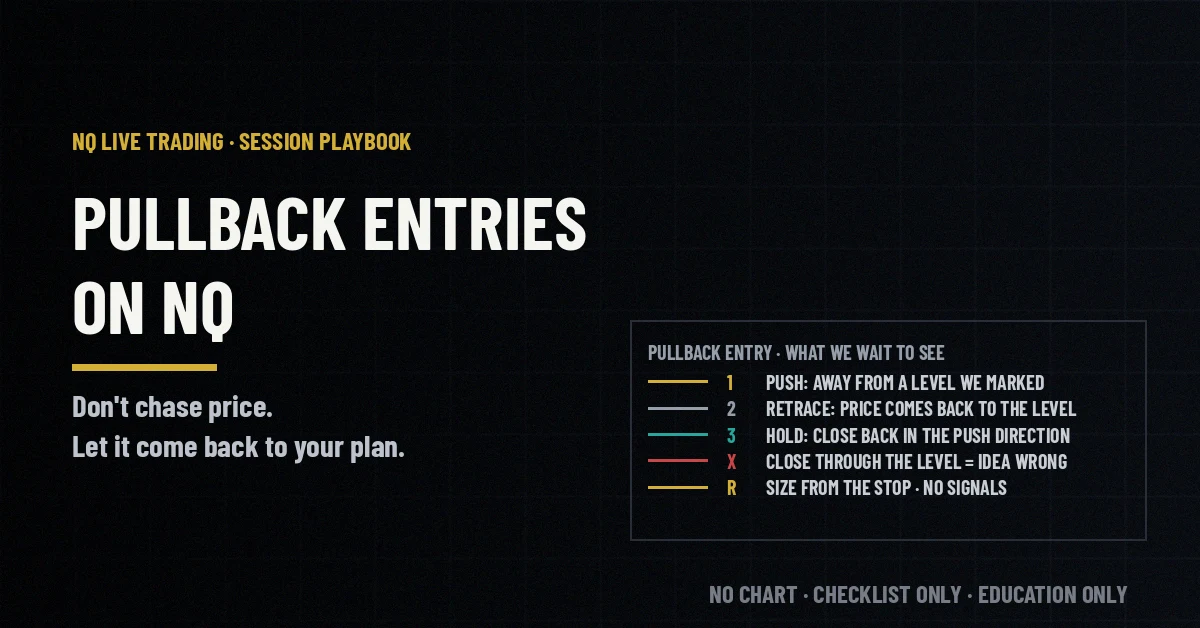
We wait for three things, in order: a clear push away from a level we marked before the open; a retrace back toward that level; and the level holding, with a candle closing back in the direction of the push. If the retrace closes back through the level instead, the idea is wrong and we stand aside. We don’t skip steps because we’re scared of missing it.
| What we see | What it tells us | What we do |
|---|---|---|
| A big push through a marked level | Something is happening | Nothing yet. Don’t buy the candle. Mark where it broke. |
| Price starts to pull back | The move is breathing | Watch where it’s heading. Is it coming back to our level? |
| Price reaches the level | The test is happening now | Watch whether the level holds from the other side. |
| A candle closes back in the direction of the push | The level is holding | Only now does a planned entry with a defined stop make sense. |
| The retrace closes back through the level | The idea is wrong | Stand aside. Re-read the map. No revenge entry. |
| Price never pulls back | We missed it | That’s fine. No trade is still a decision. |
Which levels? The same ones we mark every morning: the opening-range high and low, the prior-day high and low, and the overnight high and low. Our guide on how to read the NQ opening range in the first 30 minutes shows how we mark the box. CK Trader Pro’s guide on how to plan trade entries without chasing covers entry planning step by step, and how to read trendlines without forcing trades helps if you like to frame the push and the pullback with a simple line.
How is a pullback entry different from a breakout retest?
They’re close cousins. A retest is one kind of pullback: price comes back to the exact level it just broke. Our post on failed breakouts covers that test: did it close beyond the level, did it retest, did the level hold? A pullback entry is the entry decision that comes after a test like that holds.
If the retest fails and price closes back inside, that’s not a pullback anymore. That’s a failed breakout, and it’s a different conversation. Read failed breakouts on NQ: what we wait to see for that side of it.
How deep a pullback goes can also tell you something about the day. In my experience, shallow pullbacks that hold above the breakout can lean trend. Deep ones that give back most of the move can lean range. We walk through that in trend day or range day on NQ.
Where does the stop go on a pullback entry?
Decide where the pullback idea is wrong before you think about a target. For a long, that’s usually beyond the pullback low, on the other side of the level that was supposed to hold. For a short, it’s beyond the pullback high. Then size from that stop distance, so the planned risk is what you can afford.
Here’s a hypothetical example, not a recommendation or a prediction. Say the nearest structure is far below a chased entry, but close to an entry taken on the retrace:
- A hypothetical 25-point stop (a chased entry far from structure) is 100 ticks: $500 on one NQ contract, $50 on one MNQ contract.
- A hypothetical 10-point stop (an entry near the level that held) is 40 ticks: $200 on one NQ contract, $20 on one MNQ contract.
Same idea, same structure, very different risk. That difference is the whole reason we wait. It doesn’t make the trade more likely to work. It just means being wrong is smaller and planned.
NQ is $20 per point and $5 per tick (0.25 points), and MNQ is $2 per point and $0.50 per tick, per CME’s E-mini Nasdaq-100 and Micro E-mini Nasdaq-100 contract specifications. These stop distances are hypothetical examples, not recommendations, and they don’t include commissions, fees or slippage. If the stop beyond the pullback needs more room than your planned risk allows, trade fewer contracts, use MNQ, or pass. Run your own numbers in the NQ tick value calculator.
Stops are not guaranteed to fill at your price, and no stop guarantees a maximum loss. A stop-market order becomes a market order when it’s triggered and can fill worse in a fast market. A stop-limit order may not fill at all if price jumps past your limit. For more on choosing the level, see where to place your stop on NQ futures.
What if NQ never pulls back?
Then you missed it, and you let it go. A move that leaves without you costs you nothing. Chasing it late, far from structure, is how a missed trade turns into a real loss.
I’ve said it in class like this: “The whole point of the pullback is so you don’t chase. If it never pulls back, you missed it, and that’s completely fine.”
In my experience, this is the hardest part for many new traders. Not reading the chart. Sitting on your hands while a move runs without you. Here’s what I teach for that moment:
- Say it out loud. “I missed it. That’s fine.”
- Don’t move your level. The plan doesn’t change because price left.
- Wait for the next test. If price comes back to a level later, it’s a new setup with a new stop.
- Check your count. If you’ve hit your trade or loss limit for the day, you’re done. That’s the plan working.
If the miss turns into a chase anyway and the chase turns into a loss, our post on revenge trading NQ after a red trade covers the reset.
Are pullbacks different on opex or news days?
They can be. A pullback on a busy opex or news day can be faster or messier, and a level can get pierced before it holds. We don’t change the steps. We just give the level more time to prove itself, and we size for a wider stop or pass.
On monthly options expiration days, see NQ opex: what to know before the open for how we plan the 9:30 AM ET open. Remember: 9:30 AM ET is the U.S. stock market open, not the CME open. NQ has been trading since the prior evening, so the overnight high and low are on the map too.
How do we handle pullbacks in the live room?
At the open we mark the levels out loud. When price pushes through one, we say so, and then we wait out loud: is it pulling back, is it coming to our level, is the level holding? We don’t call trades, and we don’t tell anyone where to put orders. We teach the process so you can see it on your own chart.
Here’s how it usually sounds during the 9:30 to 10:30 AM ET session:
- The map. Opening range, prior-day high and low, overnight high and low.
- The push. “We’re through the high. Nobody chase this candle.”
- The wait. “Here’s the pullback. Is it coming back to the level? Is it holding?”
- The answer. “It held and closed back up” or “It closed back through. Idea’s wrong. Hands off.”
What don’t we do?
We don’t buy the biggest candle. We don’t promise that pullback entries work a certain percentage of the time. And we don’t widen the stop to fit a trade we’re scared to miss.
- No win rates or success rates for pullback entries.
- No entries on the push candle itself.
- No moving the level because price left without us.
- No bigger size to make up for a missed move.
Here’s the point
Chasing feels like action. Waiting feels like doing nothing. But a chased entry hands your risk to the market, and a pullback entry gives it back to you. Your job doesn’t change: mark the levels, let the push happen, wait for the retrace, see if the level holds, and size from the stop. And if it never comes back, let it go.
Remember this
You don’t chase price. You let price come back to your plan.
So here’s my question: the last time you were right about direction and still lost, did you wait for the pullback, or did you buy the candle?
See the plan live
See the plan live. We meet Monday through Friday, 9:30 to 10:30 AM ET. We mark the levels, call out the push, and wait for the retrace together, out loud, on the NQ chart. Bring your levels and your risk card. There’s no cost to attend. Join the free live room. New here? Read how the free live room works.
Registration is required. Adults 21+. Sessions are education, not signals.
The room is the free education arm of CK Trader Pro.
Join the Academy
Want the structure behind the morning? CK Trader Pro is futures and prop firm education: step-by-step lessons, live sessions and risk planning. It’s the CK Trader Pro Membership, which includes:
- Members-only educational lessons on prop-firm rules, drawdown, daily loss limits, position sizing and risk
- War Room: CK’s live pre-market planning session, weekdays 8:30–9:30 AM ET, where the day’s risk and news times get written down before the open
- CK’s chart setup, shown and explained live in every session
- Economic news calendar
Education only. No trade signals or personal advice. No results promised.
Billed monthly until you cancel. See pricing at cktraderpro.com.
The live room stays free either way.
FAQ
What is a pullback entry on NQ? It’s a planned entry after NQ has already moved, taken when price retraces back toward a level you marked before the move, like the opening-range high or the prior-day high, and that level holds. You wait for price to come back to your plan instead of buying the big candle.
Is a pullback the same as a retrace? Close enough. Both describe price moving back against the recent push for a while. A retest is one kind of pullback, where price comes back to the exact level it just broke. What matters to us is where it pulls back to, and whether that level holds.
How do you enter on a pullback in futures? Mark your levels before the open. Let the push happen without chasing it. Wait for price to retrace toward the level and for a candle to close back in the direction of the push. Then define the stop beyond the pullback and size from that distance. If the retrace closes back through the level, stand aside.
What if price never pulls back? Then you missed it, and that’s fine. A missed move costs you nothing. Chasing it late, far from structure, is how a missed trade becomes a real loss. Wait for the next test of a level, with a new stop.
Where should my stop go on a pullback entry? Where the pullback idea is wrong, usually beyond the pullback low on a long or beyond the pullback high on a short. Then size from that distance. Stops are not guaranteed to fill at your price, and no stop guarantees a maximum loss.
Do you call pullback entries in the live room? No. We mark the levels and talk through each push and pullback out loud as education. We don’t call trades, give signals or tell anyone where to place orders.
About CK
CK (George Ama) is a futures trader since 1998 and the founder of CK Trader Pro. He began as a quant analyst and started trading in the pits in 2000 before moving to the screen. Today he teaches risk-first futures education in a free live room every weekday at 9:30 AM ET.
Trading futures involves substantial risk of loss and is not suitable for everyone. Past performance is not indicative of future results. Education only, not financial advice. The live room is for adults 21+. Example numbers in this article, including stop distances and dollar amounts, are hypothetical contract math, not current prices, predictions or recommendations, and don’t include commissions, fees or slippage. Contract specs are from CME Group as of November 22, 2026; they change, so check the source before you rely on them. Quotes from CK’s classes are lightly trimmed from class recordings. No stop guarantees a maximum loss; stops are not guaranteed to fill at your price. CK Trader Pro and NQ Live Trading aren’t owned, run or endorsed by any prop firm or exchange. See our Risk Disclosure, CK Trader Pro’s Risk Disclosure and Disclosures. NQ Live Trading and CK Trader Pro are operated by CK TRADING INSTITUTE OF TECHNOLOGY LLC.