
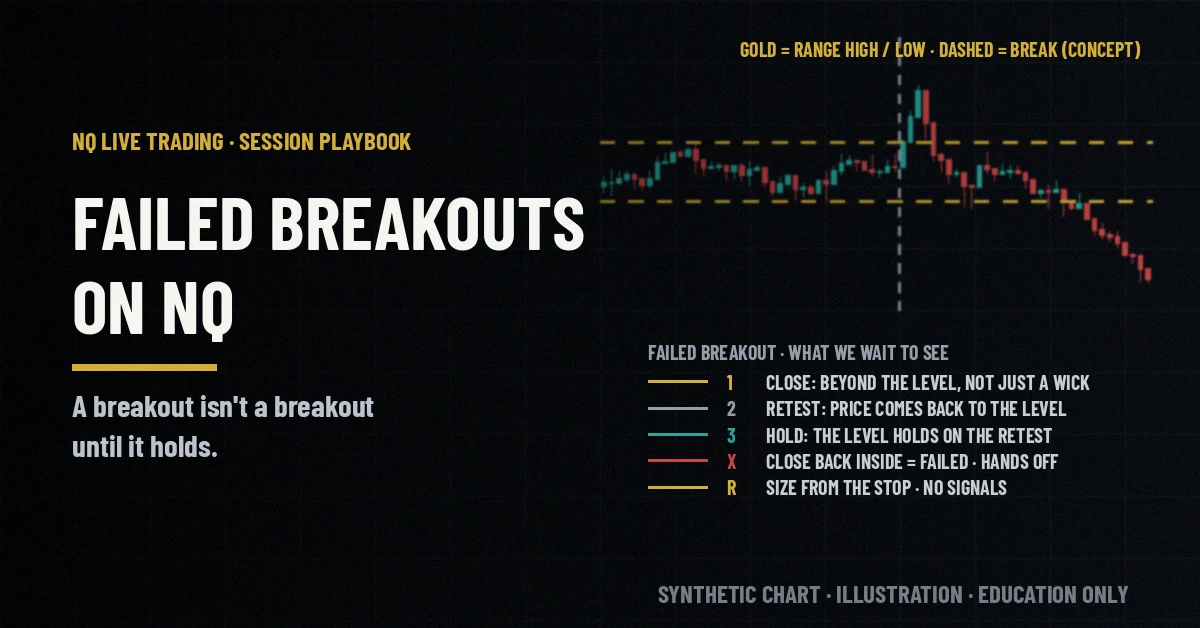
Failed Breakouts on NQ: What We Wait to See
By CK · Futures trader since 1998
Short answer: A failed breakout on NQ is when price pushes through a level you marked, like the opening-range high or yesterday’s low, and then comes right back inside instead of holding. Traders who bought or sold the break are now on the wrong side, and their exits can push price the other way. We don’t try to predict which breaks will fail. We wait to see three things before we trust any breakout: a candle close beyond the level, a retest, and the level holding on that retest. Until then, a breakout is just a question.
Education only. Futures trading involves substantial risk of loss. Not financial advice.
The breakout that turned on you
It’s 9:42 in the morning. NQ has been chopping in a box since the open. Then it pops through the top of the box. Big green candle. Your heart rate jumps.
You click buy. You’re finally in.
And two minutes later price is back inside the box. Then below the middle. Then your stop is gone.
You sit there staring at the screen. How does it do that every time I get in?
I’ve been there. Early on, I bought almost every breakout I saw, because a breakout felt like the market finally telling me what to do. It wasn’t telling me anything yet. I just wasn’t waiting long enough to hear it.
So let’s talk about what we wait to see.
Have you ever done this?
How many traders have bought the first candle through a level, only to watch it reverse before they could even set their stop?
How many traders have felt like the market “knows” where their entry is?
And how many traders have taken the loss, then jumped right back in the other direction out of anger, and gotten caught again?
None of those are bad luck. They’re timing problems. And timing is something you can control.
What is a failed breakout on NQ?
A failed breakout, also called a false breakout or a breakout trap, is a move through a marked level that doesn’t hold. Price trades beyond the level, then closes back inside the range it just left. On NQ the levels we watch for this are the ones we mark every morning: the opening-range high and low, the prior-day high and low, and the overnight high and low.
The three names mean the same thing to us:
| Term | What people mean | How we read it |
|---|---|---|
| Failed breakout | Price broke a level and couldn’t stay there | The break didn’t get accepted. Information, not a signal. |
| False breakout | Same thing, from the point of view of someone who believed it | A reminder to wait for the close. |
| Breakout trap | Same thing, from the point of view of the traders caught in it | Someone is now on the wrong side, with stops nearby. |
In my classes I’ve called them “fake outs” for years. Same idea.
Why do NQ breakouts fail?
In my experience, a breakout fails when there aren’t enough new buyers (or sellers) beyond the level to keep it going. The traders who chased the break are left holding positions that are now losing, with stops on the other side of the level. When price comes back through, their exits can add fuel to the move the other way.
Think about who’s in the trade right after a fast pop through the opening-range high:
- The chasers. They bought the big candle because it looked strong.
- The stopped-out shorts. Their buy stops sat just above the high, and the pop triggered them.
- Everyone watching. They haven’t decided yet.
If nobody new shows up above the level, the chasers are now the ones who need out. That’s the trap. Our Nov 3 Master Class recap on the AMD framework walks through this same story in more depth, including why a sweep of a level isn’t the same as a real break.
I want to be careful here. That’s an explanation of how a trap can work. It’s not a rule, and it doesn’t tell you which breakout will fail. Some breaks hold and run. That’s exactly why we wait.
Here’s the big idea
A breakout isn’t a breakout until it holds.
The first candle through a level is a question. The close, the retest and the hold are the answer.
What do we wait to see before trusting an NQ breakout?
We wait for three things, in order: a candle that closes beyond the level, not just a wick through it; a pullback that retests the broken level; and the level holding on that retest. If price closes back inside the range instead, we treat the breakout as failed and stand aside or reassess. We don’t skip steps because the candle looks strong.
| What we see | What it tells us | What we do |
|---|---|---|
| A wick through the level, close back inside | The break wasn’t accepted | Nothing. Mark it. A wick isn’t a close. |
| A candle closes beyond the level | The break might be real | Still wait. One close is a start, not proof. |
| Price pulls back to the broken level | The test is happening now | Watch whether the level holds from the other side. |
| The level holds on the retest | The break is being accepted | Only now does a planned entry with a defined stop make sense. |
| Price closes back inside the range | The breakout failed | Stand aside. Re-read the map. No revenge entry. |
Here’s how I’ve put it in class. On a long idea, I said: “We need that candle to close above that little fake out wick that shows we have strength.” And on the stop side: “especially if I get a close, then it’s a fake out, and I don’t wanna be in it anyways.”
That’s the whole discipline in two lines. Wait for the close. And if price closes back through your level, you don’t want to be in it anyway.
Why do failed breakouts happen at the open?
Because the first minutes after 9:30 AM ET, when the U.S. stock market opens, can be fast, and the opening-range high and low are levels many traders are watching at the same time. Fast moves through a widely watched level are exactly where chasing happens. We don’t publish a failure rate, because we haven’t seen a published study we’d cite. We just treat early breaks with extra patience.
Remember: 9:30 AM ET is the U.S. stock market open, not the CME open. NQ has been trading since the prior evening, so the overnight high and low are on the map too.
Our guide on how to read the NQ opening range in the first 30 minutes shows how we mark the box. And let the open talk first covers why we keep our hands off the first move. If you want the full opening-range method step by step, CK Trader Pro’s guide on how to trade the opening range lays it out.
In one class, a student said every time they went long, it went backwards. My answer: “you probably are entering it after it does that and then it goes back, right? That’s what we call fake outs. Liquidity sweeps.” In my experience, that’s how many new traders meet their first failed breakout. They enter late, on the biggest candle, right where the move runs out of new buyers.
Where does the stop go on a breakout?
Decide where the breakout idea is wrong before you think about a target. For a long through a high, that’s usually back inside the range, beyond the retest low. For a short through a low, it’s back inside, beyond the retest high. Then size from that stop distance, so the planned risk on a failed breakout is what you can afford.
Here’s a hypothetical example, not a recommendation or a prediction:
- A hypothetical 12-point stop is 48 ticks: $240 on one NQ contract, $24 on one MNQ contract.
- A hypothetical 20-point stop is 80 ticks: $400 on one NQ contract, $40 on one MNQ contract.
NQ is $20 per point and $5 per tick (0.25 points), and MNQ is $2 per point and $0.50 per tick, per CME’s E-mini Nasdaq-100 and Micro E-mini Nasdaq-100 contract specifications. These stop distances are hypothetical examples, not recommendations, and they don’t include commissions, fees or slippage. If the stop beyond the retest needs more room than your planned risk allows, trade fewer contracts, use MNQ, or pass. Run your own numbers in the NQ tick value calculator.
Stops are not guaranteed to fill at your price, and no stop guarantees a maximum loss. A stop-market order becomes a market order when it’s triggered and can fill worse in a fast market. A stop-limit order may not fill at all if price jumps past your limit. For more on choosing the level, see where to place your stop on NQ futures.
What do you do after a failed breakout catches you?
You take the planned loss and step back. You don’t flip direction out of anger, and you don’t double the size to “get it back.” A failed breakout is information about the level. It’s not a reason to trade bigger or faster.
In my experience, this is where the real damage happens. Not on the first failed breakout. On the second and third trade, taken in the next five minutes, because the first one stung.
Here’s the reset I teach:
- Hands off for a set time. Stand up. Breathe. Let a few candles print.
- Re-read the map. Where is price now versus the opening range, the prior-day levels and the overnight levels?
- Check your count. If you’ve hit your trade or loss limit for the day, you’re done. That’s the plan working.
- Only a fresh setup. If you trade again, it’s a new close, a new retest and a new stop. Not the same trade reversed.
Our post on revenge trading NQ after a red trade goes deeper on that moment. And CK Trader Pro’s guide on how to build trading discipline covers the habits that make waiting easier.
Do we trade failed breakouts the other way?
Sometimes a failed breakout sets up a trade in the other direction, but only through the same steps: a close back inside, a retest of the level from the other side, a defined stop and a size that fits. In my experience, the failed break is the start of the story, not the entry. We don’t call those trades for anyone.
A failed breakout doesn’t mean price “has to” reverse. It can just chop. It can break again later. Treat it as one more piece of the map.
How do we handle it in the live room?
At the open we mark the levels out loud, then talk through each break as it happens: did it close beyond the level, is it retesting, is the level holding? We don’t call trades, and we don’t tell anyone where to put orders. We teach the process so you can see it on your own chart.
Here’s how it usually sounds during the 9:30 to 10:30 AM ET session:
- The map. Opening range, prior-day high and low, overnight high and low.
- The question. “Price is through the high. Did it close there? Not yet.”
- The answer. “Closed back inside. That one failed. Hands off.”
What don’t we do?
We don’t chase the first candle. We don’t promise that any pattern works a certain percentage of the time. And we don’t use a failed breakout as an excuse to trade bigger.
- No win rates or success rates for breakouts or failed breakouts.
- No entries on a wick alone.
- No flipping direction out of frustration.
- No bigger size to make back a loss.
Here’s the point
Failed breakouts feel personal. They aren’t. They happen when a level gets tested and the move doesn’t get accepted, and the traders who chased the first candle are left on the wrong side. Your job doesn’t change: mark the levels, wait for the close, wait for the retest, see if the level holds, and size from the stop.
Remember this
The first candle through a level is a question. Wait for the answer.
So here’s my question: the last time a breakout turned on you, did you enter on the close and the retest, or on the first big candle?
Watch the open with us
Watch the open with us. We meet Monday through Friday, 9:30 to 10:30 AM ET. We mark the levels and walk through every break out loud on the NQ chart: the close, the retest and whether it holds. Bring your levels and your risk card. There’s no cost to attend. Join the free live room. New here? Read how the free live room works.
Registration is required. Adults 21+. Sessions are education, not signals.
The room is the free education arm of CK Trader Pro.
Join the Academy
Want the structure behind the morning? CK Trader Pro is futures and prop firm education: step-by-step lessons, live sessions and risk planning. It’s the CK Trader Pro Membership, which includes:
- Members-only educational lessons on prop-firm rules, drawdown, daily loss limits, position sizing and risk
- War Room: CK’s live pre-market planning session, weekdays 8:30–9:30 AM ET, where the day’s risk and news times get written down before the open
- CK’s chart setup, shown and explained live in every session
- Economic news calendar
Education only. No trade signals or personal advice. No results promised.
Billed monthly until you cancel. See pricing at cktraderpro.com.
The live room stays free either way.
FAQ
What is a failed breakout on NQ? It’s when NQ trades through a level you marked, like the opening-range high or the prior-day low, and then closes back inside the range instead of holding. Traders who entered on the break are left on the wrong side, and their exits can push price the other way.
What’s the difference between a false breakout and a breakout trap? Nothing, really. Failed breakout, false breakout and breakout trap all describe the same thing: a move through a level that doesn’t hold. “Trap” just describes it from the point of view of the traders caught in it.
How do you tell if an NQ breakout is real? You can’t know ahead of time. We wait for three things: a candle close beyond the level (not just a wick), a retest of the broken level, and the level holding on that retest. If price closes back inside instead, we treat the breakout as failed.
How often do NQ breakouts fail? We don’t publish a number, because we haven’t seen a published study we’d cite, and it changes with conditions. We don’t need a rate to manage the risk: wait for the close and the retest, define the stop and size from it.
Where should my stop go on a breakout trade? Where the breakout idea is wrong, usually back inside the range beyond the retest. Then size from that distance. Stops are not guaranteed to fill at your price, and no stop guarantees a maximum loss.
Do you call failed-breakout trades in the live room? No. We mark the levels and talk through each break out loud as education. We don’t call trades, give signals or tell anyone where to place orders.
About CK
CK (George Ama) is a futures trader since 1998 and the founder of CK Trader Pro. He began as a quant analyst and started trading in the pits in 2000 before moving to the screen. Today he teaches risk-first futures education in a free live room every weekday at 9:30 AM ET.
Trading futures involves substantial risk of loss and is not suitable for everyone. Past performance is not indicative of future results. Education only, not financial advice. The live room is for adults 21+. Example numbers in this article, including stop distances and dollar amounts, are hypothetical contract math, not current prices, predictions or recommendations, and don’t include commissions, fees or slippage. Contract specs are from CME Group as of November 21, 2026; they change, so check the source before you rely on them. Quotes from CK’s classes are lightly trimmed from class recordings. No stop guarantees a maximum loss; stops are not guaranteed to fill at your price. CK Trader Pro and NQ Live Trading aren’t owned, run or endorsed by any prop firm or exchange. See our Risk Disclosure, CK Trader Pro’s Risk Disclosure and Disclosures. NQ Live Trading and CK Trader Pro are operated by CK TRADING INSTITUTE OF TECHNOLOGY LLC.