
NQ Opex: What to Know Before the Open on Expiration Day
By CK · Futures trader since 1998
Short answer: “Opex” is options expiration day. For U.S. stock, ETF and index options, the monthly expiration is usually the third Friday of the month; in November 2026 that’s Friday, November 20. The NQ futures contract itself does not expire that day. The December 2026 NQ contract’s last trading day is Friday, December 18, 2026. On opex, we don’t predict anything. We know what expires, mark our levels, let the 9:30 AM ET open talk first and size from the stop.
Education only. Futures trading involves substantial risk of loss. Not financial advice.
The Friday everybody has a theory about
It’s Thursday night. You’re scrolling. Somebody says tomorrow is opex and the market will “pin.” Somebody else says it’ll explode. A third person posts a chart covered in lines and calls it a “max pain” level.
You go to bed with three theories and no plan.
Friday morning, 9:30 hits. NQ moves. And you’re not sure whether you’re trading your levels or trading somebody’s opex story.
I’ve been there. Not with opex specifically, but with every “big day” the internet tells you to be scared of. Here’s what I learned: the day doesn’t need a theory from you. It needs a plan.
So let’s take the mystery out of it.
Have you ever done this?
How many traders have heard “it’s opex” and changed their whole plan without knowing what actually expires?
How many traders have assumed their NQ futures contract expires every month, the same as the options?
And how many traders have widened a stop on a “crazy” day, without changing their size?
None of those are market problems. They’re preparation problems. And preparation is something you control.
What is opex?
Opex is short for options expiration: the day a batch of listed options stops trading and gets settled or expires. For U.S. stock, ETF and index options, the standard monthly expiration is usually the third Friday of the month. The Options Clearing Corporation (OCC) lists the monthly dates for 2026, including Friday, November 20 and Friday, December 18.
When I teach options basics in class, I say it simply: an option is a contract, and contracts expire. If the third Friday is a market holiday, the expiration moves earlier, usually to the Thursday.
You’ll find the 2026 dates in the OCC’s 2026 Holiday and Expiration Schedule (Info Memo #57897). The November monthly expiration is November 20. The December one is December 18.
What actually expires on November opex, and what doesn’t?
Several different things are called “options” around NQ, and they don’t all expire on the same day. Monthly Nasdaq-100 index options and standard monthly stock and ETF options (QQQ is an ETF) are on the third-Friday schedule. NQ futures don’t expire in November at all. Options on NQ futures at CME have their own schedule.
| Contract | Where it trades | November 2026 | What to know |
|---|---|---|---|
| Monthly Nasdaq-100 index options (NDX) | Nasdaq options exchanges | Expire Fri Nov 20 | A.M.-settled. The last trading day is the business day before (Thu Nov 19). The settlement value comes from the official opening prices of the index stocks on Friday morning. |
| Standard monthly stock and ETF options (including QQQ) | U.S. options exchanges | Fri Nov 20 is the monthly expiration | On the OCC’s monthly schedule. Weekly series can also expire on Fridays. |
| Quarterly options on NQ futures | CME | Not in November | Trading terminates at 9:30 AM ET on the third Friday of the contract month: March, June, September, December. |
| Other options on NQ futures (weekly, end-of-month) | CME | Check CME’s calendar | CME lists several expirations on NQ futures, with different days. Look them up, don’t assume. |
| NQ futures (the contract you trade) | CME | Does not expire | The December 2026 contract’s last trading day is Fri Dec 18, 2026. Trading terminates at 9:30 AM ET and it’s cash-settled. |
Sources: OCC Info Memo #57897; Nasdaq’s Options 4A rules (A.M.-settled index options, including the Nasdaq-100) and its index options explainer; CME Group’s E-mini Nasdaq-100 options specs and E-mini Nasdaq-100 futures calendar. Rules and dates can change, so check the exchange before you trade.
Here’s the part that matters for the open. Monthly NDX options settle off the opening prices of the Nasdaq-100 stocks on the third Friday. So on opex Friday, the 9:30 AM ET open isn’t only the start of the cash session. It’s also the moment that settlement value gets set. That’s information. It isn’t a trade.
Does NQ futures expire on monthly opex?
No. NQ futures follow a quarterly cycle: March, June, September and December. They stop trading at 9:30 AM ET on the third Friday of the contract month. In November there’s no NQ futures expiration. The December 2026 contract (NQZ26) has a last trading day of Friday, December 18, 2026, per CME’s calendar.
In my course, I teach it the same way: NQ and MNQ follow the quarterly cycle, March (H), June (M), September (U) and December (Z), and they expire on the third Friday of the expiration month.
That’s why December is different. On December 18, 2026, the monthly options on the OCC schedule and the December NQ futures share the same date. If you trade NQ, you’ll also need to move to the next contract before then. We’ll cover the December roll in its own post closer to the date. For now, just know which contract month is on your screen.
And if you ever hold futures overnight, especially near a contract’s last trading day, read your broker’s margin and expiration rules first. CK Trader Pro’s guide to understanding futures margin requirements covers the basics.
Does opex make NQ more volatile?
I won’t give you a number on that. I haven’t seen a published study I’d stand behind for opex-day volatility or “pinning” in NQ, so there’s no statistic on this page. And I’m not going to predict what this Friday does. In my experience, the useful question isn’t “what will opex do?” It’s “is my plan ready for whatever the open does?”
You’ll hear a lot of words on expiration days: pinning, max pain, hedging flows. Some traders study those for a living. That’s fine. But if you can’t source it and you can’t measure it, it doesn’t belong in your plan as a fact.
What does belong in your plan: your levels, your news times, your stop, your size and your trade count.
Here’s the big idea
Opex is a date on the calendar, not a direction.
You don’t need to know what the market will do on expiration day. You need to know what’s expiring, when the levels are, and how much you’re willing to lose if you’re wrong.
How do we plan the open on opex day?
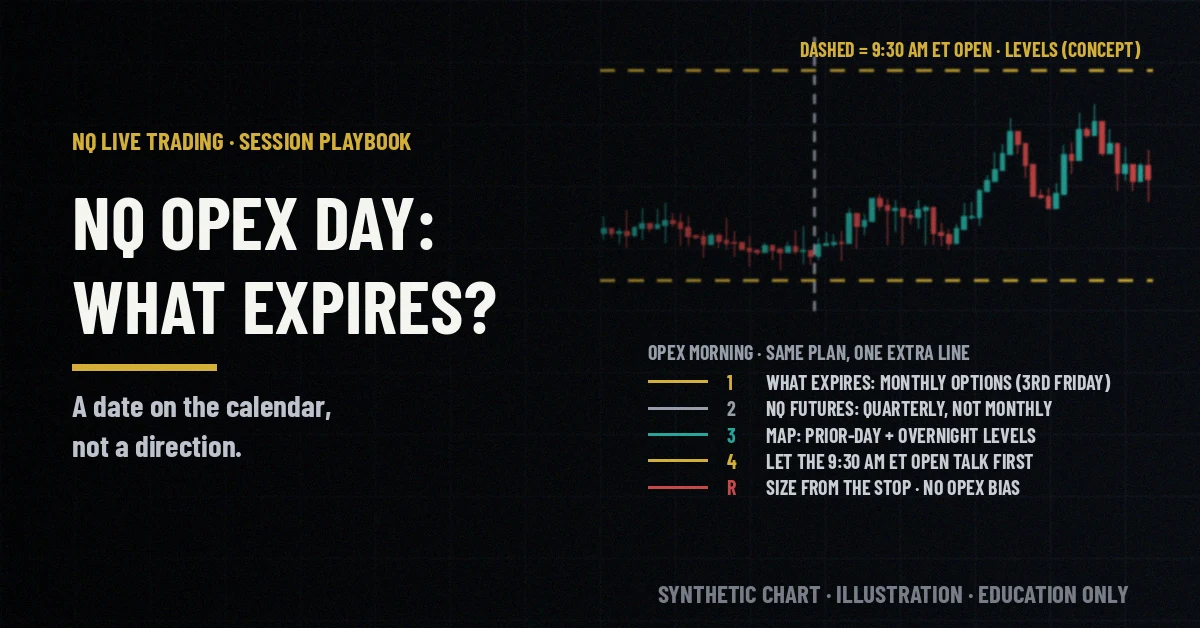
The same way we plan every open, with one extra line on the card. We write down what expires and when, check the economic calendar, mark the prior-day and overnight levels, let the 9:30 AM ET open show its hand, and size from the stop. No opex trade. No opex bias.
Here’s the checklist I use:
- Write the expiration line. “Monthly options expire today (third Friday). NQ futures don’t. Front month: December.” One line. Done.
- Check the news calendar. Opex isn’t a data release, so it won’t show up as one. Know what else is scheduled that morning. Our post on how to use the economic calendar before trading NQ walks through it.
- Mark the map. Prior-day high and low, overnight high and low, and where NQ is sitting. Our simple pre-market plan for NQ covers the order, and CK Trader Pro’s pre-market futures analysis guide goes deeper.
- Let the open talk first. The first candle is information, not a plan. See patience at the NQ 9:30 cash open.
- Read the day you’re in. Trend or range? Let price answer. Our post on NQ trend days vs range days shows how we frame it.
- Size from the stop. If the day needs more stop room, the size comes down. Never the other way around.
- Cap the trade count. A “big day” label is not a reason to take more trades.
How much does extra stop room cost on NQ?
On NQ, every point is $20 and every tick is $5. On MNQ, a point is $2 and a tick is $0.50. So if you give a trade more room on a busy morning, the dollars at risk go up with it, unless you cut size.
Here’s a hypothetical example, not a recommendation:
| Hypothetical stop | Ticks | One NQ contract | One MNQ contract |
|---|---|---|---|
| 12 points | 48 | $240 | $24 |
| 20 points | 80 | $400 | $40 |
NQ is $20 per point with a 0.25-point tick worth $5, per CME’s E-mini Nasdaq-100 contract specs, and MNQ is $2 per point and $0.50 per tick, per CME’s Micro E-mini Nasdaq-100 contract specs. These stop distances are hypothetical. They don’t include commissions, fees or slippage. If the 20-point stop is more than your planned risk on NQ, you trade MNQ, trade fewer contracts or pass. Run your own numbers in the NQ tick value calculator.
Stops are not guaranteed to fill at your price, and no stop guarantees a maximum loss. A stop-market order becomes a market order when it’s triggered and can fill worse in a fast market. A stop-limit order may not fill at all if price jumps past your limit.
What about the Monday after opex?
Treat it like any other Monday: mark the weekend gap and the Friday levels, and don’t carry Friday’s story into it. Expired options are gone. Your plan starts fresh.
In my experience, many traders carry the weekend’s headlines into Monday’s open and trade the story instead of the chart. Our post on how to read the Monday gap on NQ covers what we mark before that open.
How do we handle opex in the live room?
We say it out loud before 9:30: “It’s monthly opex. Here’s what expires. NQ futures don’t.” Then we run the same routine as every other morning. We mark levels, watch the open, and talk through what price is doing. We don’t call trades, and we don’t tell anyone where to put orders.
Here’s how it usually sounds during the 9:30 to 10:30 AM ET session:
- The expiration line. What expires, what doesn’t, which contract month we’re watching.
- The map. Prior-day high and low, overnight high and low.
- Hands off the first move. Note the speed and which level got hit.
- The read. Acceptance or rejection at the levels. Trend or range.
- The math. Stop distance first, then size. Too big? Size down or pass.
What don’t we do on opex?
We don’t trade a theory. We don’t predict a pin, a squeeze or a direction. And we don’t let a calendar label talk us out of our own risk rules.
- No “opex level” treated as a signal.
- No volatility or pinning statistics without a published source.
- No bigger size because “it’s a big day.”
- No confusing an options expiration with an NQ futures expiration.
Here’s the point
Opex sounds dramatic. It isn’t magic. On the third Friday, a batch of monthly options expires, and monthly Nasdaq-100 index options settle off Friday’s opening prices. NQ futures don’t expire in November; the December contract’s last day is December 18. Your job doesn’t change: know the date, write the line, mark the map, let the open talk first and size from the stop.
Remember this
Know what expires. Then trade your plan, not the calendar.
So here’s my question: the last time someone told you “it’s a big day,” did you change your plan, or just your nerves?
Join the room
Join the room. We meet Monday through Friday, 9:30 to 10:30 AM ET, and on opex mornings we say what expires, mark the levels and walk through the open out loud on the NQ chart. Bring your expiration line and your risk card. There’s no cost to attend. Join the free live room. New here? Read how the free live room works.
Registration is required. Adults 21+. Sessions are education, not signals.
The room is the free education arm of CK Trader Pro.
Join the Academy
Want the structure behind the morning? CK Trader Pro is futures and prop firm education: step-by-step lessons, live sessions and risk planning. It’s the CK Trader Pro Membership, which includes:
- Members-only educational lessons on prop-firm rules, drawdown, daily loss limits, position sizing and risk
- War Room: CK’s live pre-market planning session, weekdays 8:30–9:30 AM ET, where the day’s risk and news times get written down before the open
- CK’s chart setup, shown and explained live in every session
- Economic news calendar
Education only. No trade signals or personal advice. No results promised.
Billed monthly until you cancel. See pricing at cktraderpro.com.
The live room stays free either way.
FAQ
What does opex mean for NQ traders? Opex means options expiration. For U.S. stock, ETF and index options, the standard monthly expiration is usually the third Friday of the month, per the OCC’s schedule. NQ futures don’t expire on monthly opex; they follow a quarterly cycle. For an NQ trader, opex is a date to know, not a direction.
When is November 2026 opex? Friday, November 20, 2026, per the OCC’s 2026 expiration schedule (Info Memo #57897). The next monthly expiration is Friday, December 18, 2026.
Do NQ futures expire on options expiration day? Not in November. NQ futures expire quarterly, in March, June, September and December, with trading ending at 9:30 AM ET on the third Friday of the contract month. The December 2026 contract’s last trading day is December 18, 2026, which is also the OCC’s December monthly expiration date.
What happens to NDX options at the open on opex Friday? Monthly NDX options are A.M.-settled. They stop trading the business day before, and their settlement value comes from the official opening prices of the Nasdaq-100 stocks on the third Friday. That’s why the 9:30 AM ET open on opex Friday is also a settlement moment.
Is NQ more volatile on opex? We don’t publish a number on that. We haven’t seen a published study we’d cite for opex-day volatility or pinning in NQ, so we don’t give one, and we don’t predict what any Friday will do. We plan the open the same way every day and size from the stop.
Does a wider stop on opex protect me? No. A wider stop means more dollars at risk per contract unless you cut size. Stops are not guaranteed to fill at your price, and no stop guarantees a maximum loss. A stop-market order can fill past your stop in a fast market, and a stop-limit may not fill at all.
About CK
CK (George Ama) is a futures trader since 1998 and the founder of CK Trader Pro. He began as a quant analyst and started trading in the pits in 2000 before moving to the screen. Today he teaches risk-first futures education in a free live room every weekday at 9:30 AM ET.
Trading futures involves substantial risk of loss and is not suitable for everyone. Past performance is not indicative of future results. Education only, not financial advice. The live room is for adults 21+. Example numbers in this article, including stop distances and dollar amounts, are hypothetical contract math, not current prices, predictions or recommendations, and don’t include commissions, fees or slippage. Expiration dates and contract rules are from OCC, Nasdaq and CME Group as of November 19, 2026 and can change; check the exchange before you trade. No stop guarantees a maximum loss; stops are not guaranteed to fill at your price. CK Trader Pro and NQ Live Trading aren’t owned, run or endorsed by any prop firm or exchange. See our Risk Disclosure, CK Trader Pro’s Risk Disclosure and Disclosures. NQ Live Trading and CK Trader Pro are operated by CK TRADING INSTITUTE OF TECHNOLOGY LLC.