
Daily Gaps on NQ: Fill, Hold or Ignore?
By CK · Futures trader since 1998
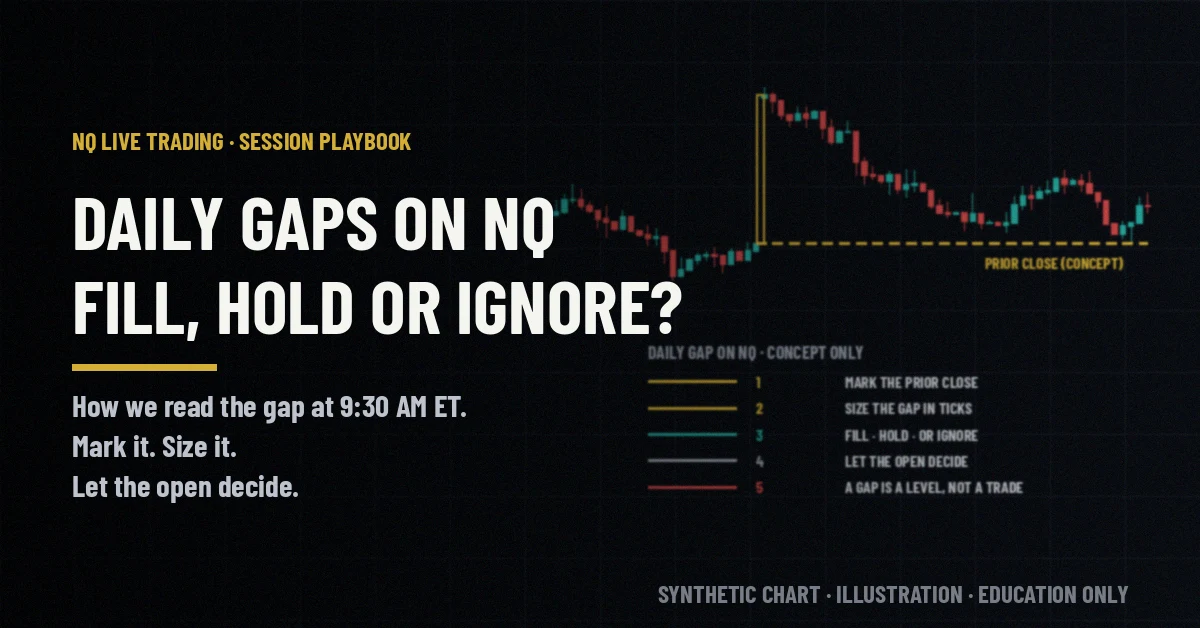
Short answer: In this article, a daily gap on NQ is the distance between your chosen prior-session NQ reference close and where NQ trades at the 9:30 AM ET U.S. stock market open. After the open, a gap can fill (price trades back to the prior close), hold (price stays away from it), or simply not matter that day. In the live room we don’t assume any of the three. We mark the gap, size it in points and dollars, and let the first part of the session show us which one it’s becoming.
Education only. Futures trading involves substantial risk of loss. Not financial advice.
The gap that “has to fill”
It’s 9:25 AM ET. NQ is trading above yesterday’s close. Someone in the chat types, “Gaps always fill.”
Maybe it fills by 9:45. Maybe it fills next week. Maybe it never comes back to that price at all.
That one sentence, “gaps always fill,” turns a reference point into a promise. This post is about taking the promise out and keeping the reference point.
Have you ever traded a gap like this?
How many traders short the open just because NQ gapped up, with no level, no stop plan and no reason except “it has to fill”?
How many traders hold a losing trade because the gap “hasn’t filled yet,” as if the market owes them the trip?
And how many traders measure the gap from a different “close” every morning, then wonder why their gap never matches anyone else’s?
None of those are chart problems. They’re expectation problems.
What is a daily gap on NQ?
Here, a daily gap is the difference between a prior NQ reference close you’ve defined and the NQ price at the 9:30 AM ET U.S. stock market open. NQ trades nearly around the clock on CME Globex, Sunday to Friday, 6:00 PM to 5:00 PM ET, with a daily break from 5:00 to 6:00 PM ET (CME NQ specifications). These are normal hours; holidays, price limits and regulatory trading halts can interrupt trading (see CME Rule 35902.I). This reference gap is not necessarily a jump across a period with no NQ trading. The gap is the overnight move, measured against the close you chose.
Two things to know before you trade around one:
- 9:30 AM ET is the U.S. stock market open, not NQ’s open (NYSE hours and calendars). That’s why so many traders use it as the reference moment for the gap.
- The “close” is your choice, so make it once. Daily futures settlement, the NQ price at the normal 4:00 PM ET stock close, or the last NQ trade before the 5:00 PM ET break can all differ. Settlement is an exchange-calculated value, not simply the last trade or the stock closing price. We walk through that choice in NQ premarket levels we mark before the 9:30 open. Pick one, write it on your card, and use it every day.
A Monday gap is its own animal, because it covers a whole weekend. That’s in how to read the Monday gap on NQ. This post is about the ordinary weekday gap.
Does NQ always fill its gaps?
No. Some gaps fill the same morning, some fill days later, and some don’t fill at all within any time frame that matters to a day trader. We don’t quote a fill percentage here, because we haven’t found a published study we’d stand behind. In my experience, any “gaps fill X% of the time” number you see online depends heavily on how the gap and the time window were defined.
So we don’t start the morning with a prediction. We start with three possible outcomes and a plan for each.
| What the gap does | What it looks like after 9:30 | How we treat it in the room |
|---|---|---|
| Fills | Price trades back to the prior close you marked | The prior close becomes the level to watch for a reaction, not a finish line |
| Holds | Price stays away from the prior close and builds structure on the gap side | The gap edge and the opening range become the map; we stop waiting for the fill |
| Doesn’t matter | Price chops inside the overnight range and the prior close is far away or irrelevant | We take the gap off the front of the card and trade the levels that are actually in play |
That third row is the one many traders skip. Not every gap deserves a plan.
Here’s the big idea
A gap is a level, not a trade.
Many traders treat the prior close like a magnet. We treat it like a line on the map. Price might visit it. Price might ignore it. Either way, our job is to know where it is and what our risk is if we’re wrong.
How big is the gap in points and dollars?
Gap size is just points times contract value. NQ is $20 per point and $5 per 0.25-point tick; MNQ is $2 per point and $0.50 per tick (CME NQ specs; CME MNQ specs).
Here’s a hypothetical example, contract math only. It’s not a forecast and not a trade idea. Dollar figures are before commissions, fees and slippage; gap distance is not a maximum-loss allowance.
| Hypothetical gap | Ticks (0.25 pt) | Distance on 1 NQ | Distance on 1 MNQ |
|---|---|---|---|
| 15 points | 60 | $300 | $30 |
| 30 points | 120 | $600 | $60 |
| 60 points | 240 | $1,200 | $120 |
Here’s why this matters. If someone is “fading the gap” on one NQ contract and the gap is 60 points, the trip back to the prior close is $1,200 of price movement, and a further 60-point move against that position also represents $1,200 before costs. Adverse movement is not limited to 60 points. Run your own numbers in the NQ tick value calculator.
If you place a stop near a gap edge or the prior close, know how your order behaves in a fast open. Stops are not guaranteed to fill at your price, and no stop guarantees a maximum loss.
What do we watch to tell fill from hold?
We watch where the open settles against the levels we marked, not the gap by itself. These are the questions we ask out loud in the room. They’re how we read context, not a signal list.
- Where is the gap against the prior-day high and low? A gap that opens inside yesterday’s range reads differently from one that opens above the high or below the low. That map comes first: prior-day high and low as your first map.
- How big is the gap compared to the overnight range? If the gap is small and the overnight range was tight, the prior close may be right in play. If the gap is large, the prior close may be too far away to matter this morning.
- What did the opening range do? We let the first 15–30 minutes print before we decide anything. See reading the NQ opening range in the first 30 minutes.
- Was there scheduled news? A gap built on an 8:30 AM ET release isn’t the same as a quiet overnight drift. On news mornings we wait the number out, then re-read the map.
- Where’s VWAP once the session has volume? It’s a supporting line, not the decider. See VWAP on NQ: how we use it and when we ignore it.
In my experience, the answer to “fill or hold?” usually shows up in the structure after the open, not in the gap itself.
When do we ignore the gap completely?
When it’s too small to matter, too far away to be central to our plan, or buried under news. Three common mornings:
- The tiny gap. A few points from the prior close is inside normal noise. We note it and move on.
- The far-away gap. Price opens well beyond yesterday’s high or low and builds there. The prior close isn’t the story today.
- The news-driven gap. When the overnight move came from a scheduled release, the levels formed after the release often matter more than the old close.
Ignoring the gap isn’t ignoring risk. It’s refusing to let one old price run the whole morning. Our simple pre-market plan for NQ keeps the card short so the levels that matter stay at the top. CK Trader Pro goes deeper on that routine in pre-market futures analysis.
Here’s the point
You don’t need to predict whether today’s gap fills. You need to know where it is, how big it is in dollars, and what would tell you it’s filling, holding, or not worth your attention.
Remember this
Mark it. Size it. Let the open decide. And never hold a trade because a gap “owes” you a fill.
So here’s my question: before Monday’s open, can you write down your prior close, your gap size in ticks, and what would make you ignore it?
Watch it live
Weekend prep for Monday’s room. Bring your gap math. We meet Monday through Friday, 9:30 to 10:30 AM ET, with the prior close, the overnight range and the prior-day levels on the chart, and we talk through how NQ treats them as the open forms. There’s no cost to attend. Join the free live room and watch whether the gap fills, holds or just doesn’t matter.
Registration is required. Adults 21+. Sessions are education, not signals.
The room is the free education arm of CK Trader Pro.
Join the Academy
Want the structure behind the morning? CK Trader Pro is futures and prop firm education: step-by-step lessons, live sessions and risk planning. It’s the CK Trader Pro Membership, which includes:
- Members-only educational lessons on prop-firm rules, drawdown, daily loss limits, position sizing and risk
- War Room: CK’s live pre-market planning session, weekdays 8:30–9:30 AM ET, where the day’s risk and news times get written down before the open
- CK’s chart setup, shown and explained live in every session
- Economic news calendar
Education only. No trade signals or personal advice. No results promised.
Billed monthly until you cancel. See pricing at cktraderpro.com.
The live room stays free either way.
FAQ
What is a gap on NQ futures? Here, it’s the difference between your chosen prior NQ reference close (daily futures settlement, the NQ price at the normal 4:00 PM ET stock close, or the last NQ trade before the 5:00 PM ET break) and where NQ trades at the 9:30 AM ET U.S. stock market open, not NQ’s session open.
Does NQ always fill its gaps? No. Some gaps fill the same morning, some fill later, and some don’t fill within a useful time frame. We don’t quote a fill rate because we haven’t found a published study we’d stand behind.
Is a gap fill a trade signal? We don’t use it that way. In the live room the prior close is a level to watch for a reaction, alongside the prior-day high and low, the overnight range and the opening range.
How is a daily gap different from a Monday gap? Here, an ordinary weekday gap spans one overnight period. A Monday 9:30 AM ET reference gap also spans the weekend and Sunday-night trading. NQ normally closes Friday at 5:00 PM ET and reopens Sunday at 6:00 PM ET; holiday schedules and trading halts can alter availability.
How do I convert an NQ gap into dollars? Multiply the gap in points by $20 per NQ contract (or $2 per MNQ). One 0.25-point tick is $5 on NQ and $0.50 on MNQ, per CME contract specs. These dollar distances are before commissions, fees and slippage, not guaranteed maximum losses. Use the NQ tick value calculator for your own numbers.
About CK
CK (George Ama) is a futures trader since 1998 and the founder of CK Trader Pro. He is the author of The Risk First Series, including Risk First: The NQ Futures Playbook and Risk First: Execution.
Trading futures involves substantial risk of loss and is not suitable for everyone. Past performance is not indicative of future results. Education only, not financial advice. The live room is for adults 21+. Example numbers in this article are hypothetical contract math, not predictions or recommendations. No stop guarantees a maximum loss; stops are not guaranteed to fill at your price. CK Trader Pro and NQ Live Trading aren’t owned, run or endorsed by any prop firm. See our Risk Disclosure, CK Trader Pro’s Risk Disclosure and Disclosures. NQ Live Trading and CK Trader Pro are operated by CK TRADING INSTITUTE OF TECHNOLOGY LLC.