
VWAP on NQ: How We Use It (and When We Ignore It)
By CK · Futures trader since 1998
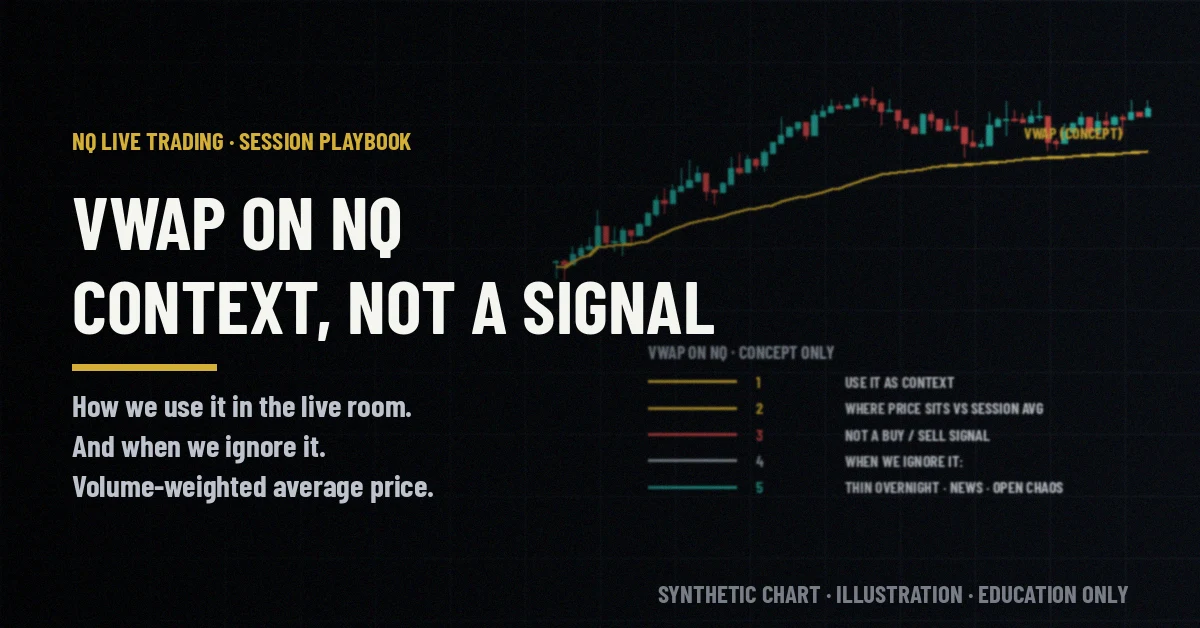
Short answer: VWAP is the volume-weighted average price for a session — the average price paid, weighted by how much traded at each price. In the live room we use it as context (where NQ sits versus that session average), not as a buy or sell signal. On thin overnight tape, news spikes and early open chaos, we often ignore it until the session has enough volume to mean something.
Education only. Futures trading involves substantial risk of loss. Not financial advice.
The line everyone stares at
It’s a few minutes after 9:30 AM ET. Someone in the room asks, “Where’s VWAP?”
Price is above it. Or below it. Or sitting on it. And that one fact starts to feel like a decision.
This post is about slowing that moment down. What VWAP actually is, how we use it on NQ as context, and the mornings we leave it alone on purpose.
Have you ever done this with VWAP?
How many traders can tell you NQ is “above VWAP” but can’t say what that number is made of?
How many traders treat a VWAP cross as a signal, even when the overnight session was thin or a news spike just reset the tape?
And how many traders mark VWAP, the opening range and prior-day levels, then still trade the first candle like none of those lines exist?
None of those are software problems. They’re context problems.
What is VWAP in plain English?
VWAP is the volume-weighted average price for a trading session: the average price paid, weighted by how much volume traded at each price (Investopedia: Volume-Weighted Average Price). Platforms usually approximate it from each bar’s typical price times volume, then keep a running total from the session open. It resets when a new session starts. Exact session settings depend on your platform.
What that means on an NQ chart:
- It is a calculation, not a product. We teach the concept. We don’t sell or recommend an indicator pack.
- It is one session’s weighted average. It is not a forecast of where price “should” go next.
- Distance from VWAP is just distance. Convert it to points and dollars so it stays real. NQ is $20 per point and $5 per 0.25-point tick; MNQ is $2 per point and $0.50 per tick (CME NQ specs; CME MNQ specs).
How do we use VWAP in the live room?
We use it as context: where price sits versus the session’s volume-weighted average, alongside the levels we already marked. It is not a buy signal when price is above it, and it is not a sell signal when price is below it.
In the room, VWAP answers one question: “Relative to where volume has traded so far today, is NQ trading rich, cheap or near the average?” That answer only matters after we’ve read the chart in order — axis, overnight session, structure, levels, then candles — the same method as how to read an NQ chart before the open.
What VWAP is good for in that order:
- A second reference after prior-day and overnight levels. See prior-day high and low as your first map.
- A check against the opening range once the first 15–30 minutes print. See reading the NQ opening range in the first 30 minutes and CK Trader Pro’s how to trade the opening range.
- A line on the pre-market card only when the overnight session had enough volume to care. Our simple pre-market plan for NQ is still levels and risk first.
In my experience, VWAP is most useful when you can say in one sentence why you’re looking at it. If you can’t, leave it off the chart for that morning.
Here’s the big idea
VWAP describes where volume has traded. It does not tell you what to do next.
Many traders treat the line like a referee. We treat it like a summary of the session so far — useful when the session has enough volume to summarize, and noisy when it doesn’t.
How far is NQ from VWAP in points and dollars?
Distance from VWAP is just points times contract value. Here’s a hypothetical example, contract math only — not a forecast and not a trade idea.
| Hypothetical distance from VWAP | Ticks (0.25 pt) | Per 1 NQ | Per 1 MNQ |
|---|---|---|---|
| 5 points | 20 | $100 | $10 |
| 10 points | 40 | $200 | $20 |
| 25 points | 100 | $500 | $50 |
| 50 points | 200 | $1,000 | $100 |
These are sizes of a hypothetical gap between price and VWAP, not a target and not a signal. Run your own numbers in the NQ tick value calculator. In my experience, a “15 points above VWAP” comment lands differently once you see it as $300 on one NQ contract.
If you use stops near that distance, know how your order type behaves in a fast market. Stops are not guaranteed to fill at your price, and no stop guarantees a maximum loss.
When do we ignore VWAP on NQ?
We ignore it when the session average isn’t meaningful yet: thin overnight volume, a news spike that resets the tape, or the first chaotic minutes of the open.
Three mornings where VWAP often waits:
- Thin overnight. NQ trades on CME Globex Sunday to Friday, 6:00 PM to 5:00 PM ET, with a daily break from 5:00 to 6:00 PM ET (CME Group trading hours). Overnight candles are real trading, but volume can be light. A VWAP built mostly on thin Globex hours can sit far from where the regular session will actually trade. The 9:30 AM ET open is the U.S. stock market open, not NQ’s open (NYSE hours and calendars).
- News spikes, including jobs Fridays. A scheduled release can shove price through levels in seconds. On those mornings we wait the number out and re-read the map after — see NQ on jobs report Friday. VWAP calculated through the spike is still math, but we don’t treat it as the first line that matters.
- Early open chaos. The first minutes after 9:30 can print a range that isn’t settled yet. We let the opening range form, then check VWAP against that range and the prior-day map — not the other way around.
Ignoring VWAP isn’t ignoring the market. It’s refusing to give a half-built average more weight than the levels you wrote down before the open.
How does VWAP fit with our other morning lines?
VWAP is a supporting line, not the map. The map is still prior-day high and low, the overnight range, the opening range and the risk you wrote on the card.
| Line | What it answers | When we lean on it |
|---|---|---|
| Prior-day high / low | Where did yesterday’s session matter? | Almost every morning (map) |
| Overnight high / low | Where did Globex travel? | Before 9:30, every day |
| Opening range | Where did the first 15–30 minutes settle? | After the open forms |
| VWAP | Where is the session’s volume-weighted average so far? | When volume is enough to care |
That order matches the pre-market card. Write the levels and the max risk first. Add VWAP only if it earns a sentence on the card.
Here’s the point
You don’t need VWAP to “work” for you. You need to know what it measures, when that measurement is useful, and when a thin or shocked session makes it noise.
Remember this
Context, not a signal. Use it when volume can support it. Ignore it when the session average isn’t ready yet.
So here’s my question: next time someone says “price is above VWAP,” can you say in one sentence what that actually means for today’s session?
Watch it live
See VWAP on the live screen as context, not as a signal. We meet Monday through Friday, 9:30 to 10:30 AM ET, with the morning’s levels on the chart, and we talk through how NQ treats them as the open forms. There’s no cost to attend. Join the free live room and see when we use the line — and when we leave it alone.
Registration is required. Adults 21+. Sessions are education, not signals.
The room is the free education arm of CK Trader Pro.
Join the Academy
Want the structure behind the morning? CK Trader Pro is futures and prop firm education: step-by-step lessons, live sessions and risk planning. It’s the CK Trader Pro Membership, which includes:
- Members-only educational lessons on prop-firm rules, drawdown, daily loss limits, position sizing and risk
- War Room: CK’s live pre-market planning session, weekdays 8:30–9:30 AM ET, where the day’s risk and news times get written down before the open
- CK’s chart setup, shown and explained live in every session
- Economic news calendar
Education only. No trade signals or personal advice. No results promised.
Billed monthly until you cancel. See pricing at cktraderpro.com.
The live room stays free either way.
FAQ
What is VWAP on NQ? VWAP is the volume-weighted average price for a session: the average price paid, weighted by volume. Platforms usually approximate it from each bar and reset it when a new session starts.
Is VWAP a buy or sell signal? We don’t use it that way. In the live room VWAP is context for where price sits versus the session average, alongside prior-day levels and the opening range.
When should traders ignore VWAP on NQ? When the average isn’t meaningful yet: thin overnight volume, a news spike such as the jobs report, or the first chaotic minutes of the open before the opening range settles.
How do I convert distance from VWAP into dollars on NQ? Multiply the point distance by $20 per NQ contract (or $2 per MNQ). One 0.25-point tick is $5 on NQ and $0.50 on MNQ, per CME contract specs. Use the NQ tick value calculator for your own numbers.
Do you sell a VWAP indicator? No. We teach VWAP as a concept and calculation only. We don’t sell or recommend an indicator product.
About CK
CK (George Ama) is a futures trader since 1998 and the founder of CK Trader Pro. He is the author of The Risk First Series, including Risk First: The NQ Futures Playbook and Risk First: Execution.
Trading futures involves substantial risk of loss and is not suitable for everyone. Past performance is not indicative of future results. Education only, not financial advice. The live room is for adults 21+. Example numbers in this article are hypothetical contract math, not predictions or recommendations. No stop guarantees a maximum loss; stops are not guaranteed to fill at your price. CK Trader Pro and NQ Live Trading aren’t owned, run or endorsed by any prop firm. See our Risk Disclosure, CK Trader Pro’s Risk Disclosure and Disclosures. NQ Live Trading and CK Trader Pro are operated by CK TRADING INSTITUTE OF TECHNOLOGY LLC.