
Trading NQ on FOMC Day: How We Handle It Live
By CK · Futures trader since 1998
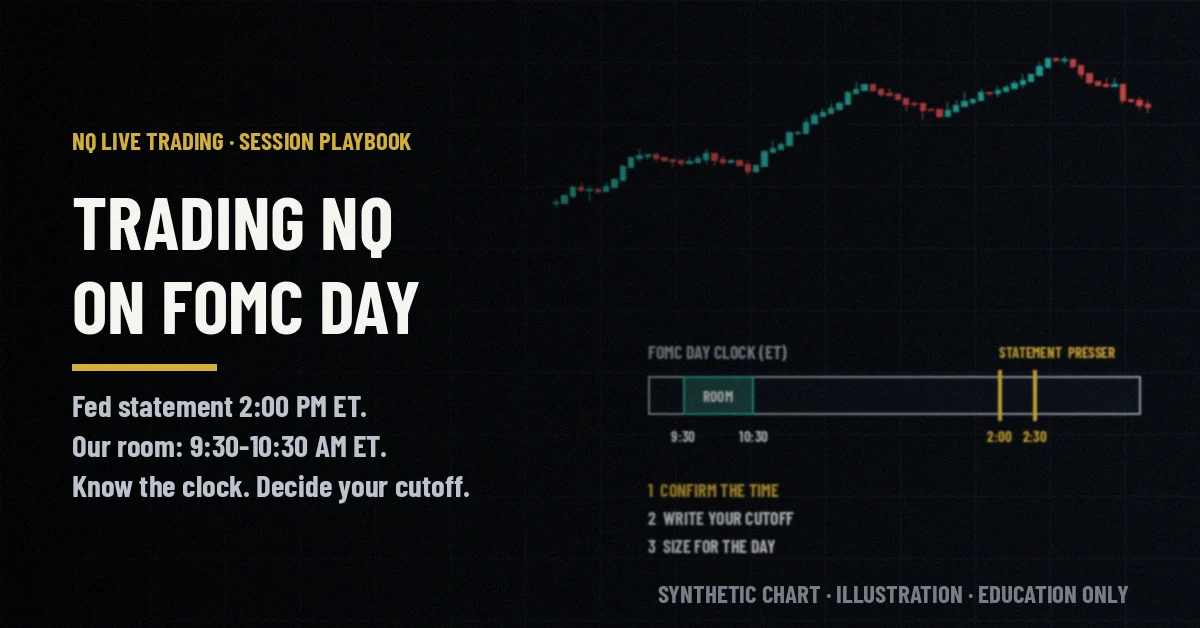
Short answer: On FOMC day, the Federal Reserve releases its policy statement at 2:00 PM ET and the Chair’s press conference starts at 2:30 PM ET (Federal Reserve calendar). Our free live room runs 9:30 to 10:30 AM ET, so we trade the morning, hours before the decision, with the same levels, fewer trades and a cutoff written down before the open.
Education only. Futures trading involves substantial risk of loss. Not financial advice.
The two o’clock problem
Every Fed day has a clock in it. You can see it on the calendar before the session starts: 2:00 PM ET, statement; 2:30 PM ET, press conference.
And yet the morning still feels heavy. Some traders sit on their hands at 9:30 because “the Fed is today.” Others size up because they think a big day is coming. Neither one is a plan. Both are reactions to an event that hasn’t happened yet.
I’ve been trading futures since 1998. On Fed day, the trader who gets hurt often isn’t the one who misread the decision. It’s the one who never decided, before the open, what they’d do about it.
Have you ever noticed this about Fed days?
How many traders check the FOMC date on Monday, then forget it until a position is open at 1:58 PM?
How many traders widen a stop “just for today,” then find the fill was worse than the stop?
And how many traders blame the Fed for a loss that really came from a size they never would have taken on a normal Tuesday?
Those aren’t forecasting problems. They’re planning problems, and planning happens before 9:30.
What is FOMC day, and when does the news come out?
FOMC day is the final day of a Federal Open Market Committee meeting, when the Fed releases its policy decision. The FOMC holds eight regularly scheduled meetings a year, plus others as needed, and publishes the dates in advance (Fed FOMC calendar). The statement comes out at 2:00 PM ET and the press conference begins at 2:30 PM ET.
Here’s what to put on your own calendar, all from federalreserve.gov:
| Release | Time (ET) | Source |
|---|---|---|
| Policy statement and implementation note | 2:00 PM, final day of the meeting | Fed press-conference page (“Released … at 2:00 p.m.”) |
| Chair’s press conference | 2:30 PM, same day | Fed monthly calendar |
| Summary of Economic Projections (the “dot plot”) | With the statement, at four meetings a year (March, June, September, December on the current calendar) | Fed FOMC calendar (meetings marked *) |
| Minutes | 2:00 PM, three weeks after the decision (regularly scheduled meetings) | Fed FOMC calendar; Fed monthly calendar |
Two notes. Scheduled meetings on the current calendar are two-day meetings, and the decision comes on day two. And the Fed says each meeting date “is tentative until confirmed at the meeting immediately preceding it,” so check the calendar the week of, not just once a year (Fed FOMC calendar).
Our guide to using the economic calendar before trading NQ shows where this fits in the weekly check, along with the 8:30 and 10:00 AM ET reports that can land on the same morning.
Here’s the big idea
On Fed day, the decision isn’t your trade. Your plan is.
Nobody in the room knows what the statement will say. What we do know is the time it comes out, the time our session ends, and how much we’re willing to lose today. Those three facts are enough to plan the whole day.
How do we trade the NQ morning on FOMC day?
We run the same morning process we run every day: same levels, smaller expectations, fewer trades and a fixed stop time. The room ends at 10:30 AM ET, about three and a half hours before the 2:00 PM statement. The decision doesn’t change the map; it changes how much we ask of the morning.
Here’s how we approach it in the room:
- Same map. We still mark the prior-day high and low and watch how NQ treats them.
- Let the open talk first. We read the opening range in the first 30 minutes before we lean on any idea. On a Fed morning, that range can be tighter than usual, though there’s no guarantee of that.
- Smaller targets are fine. If NQ is rotating, a target that made sense on a trend day may not be realistic.
- Fewer trades, not more. A slow morning tempts traders to force entries. A trade-count cap you set before the open helps more than a feeling.
- A written cutoff. Our session ends at 10:30 AM ET. Deciding your flat time before the open is one of the most useful Fed-day habits.
What changes around the 2:00 PM statement?
Around a major release, several things can change at once: spreads can widen, fewer orders can sit at each price, and price can jump past levels between trades. The first move after the statement can also reverse during the 2:30 PM ET press conference. None of that makes Fed-day trading off-limits, but the risk you planned may not be the risk you get.
Here’s the part many traders skip. A stop order becomes a market order when it triggers, so it fills at the next available price, which can be worse than your stop. That gap is slippage. Stops are not guaranteed to fill at your price, and no stop guarantees a maximum loss.
Here’s the math on a hypothetical slip, using CME contract specs (NQ: 0.25-point tick = $5, so $20 per point; MNQ: 0.25-point tick = $0.50, so $2 per point; sources: CME E-mini Nasdaq-100 specs, CME Micro E-mini Nasdaq-100 specs):
| Hypothetical slip past your stop | Ticks | Extra loss, 1 NQ | Extra loss, 1 MNQ |
|---|---|---|---|
| 2 points | 8 | $40 | $4 |
| 5 points | 20 | $100 | $10 |
| 10 points | 40 | $200 | $20 |
These are illustrations, not predictions. Fills can be better or worse. Run your own numbers in the NQ tick value calculator, and see how we size NQ vs MNQ by risk.
If you trade a prop-firm evaluation, check your firm’s rules before the release; some firms restrict trading around major news, and the rules vary by firm and account type. CK Trader Pro’s guide to prop firm drawdown management explains why one outsized loss can matter more than a string of small ones. Prop-firm evaluations and funded accounts are typically simulated.
What does a simple FOMC day checklist look like?
Five steps, all done before 9:30 AM ET: confirm the times, set a cutoff, size for the day, keep your loss limit fixed, and plan to log it. It takes a few minutes, and it turns “the Fed is today” from a mood into a plan.
- Confirm the time. Check the Fed’s calendar for the statement (2:00 PM ET) and press conference (2:30 PM ET), plus any 8:30 or 10:00 AM ET reports that morning.
- Pick your flat time. Write it in your plan before the open. Ours is 10:30 AM ET, when the room ends.
- Size for the day you’re in. If you trade near the release at all, consider fewer contracts, or MNQ instead of NQ.
- Keep your daily loss limit fixed. Don’t widen it because it’s Fed day.
- Log it. Write down whether you followed the plan, not just how the trade ended.
Here’s the point
Past Fed-day moves don’t predict the next one. The goal isn’t to guess the decision. It’s to make sure one afternoon can’t undo a week of careful trading.
Remember this
Know the clock. Decide your cutoff. Size for the day you’re in.
So here’s my question: on the next FOMC day, will you have your flat time written down before 9:30, or will you decide it at 1:58?
Watch it live
See how we plan the room on news days. On Fed days we still meet Monday through Friday, 9:30 to 10:30 AM ET, and talk through the morning’s levels, trade count and when we’re done for the day. There’s no cost to attend. Join the free live room and watch how we handle the next FOMC morning.
Registration is required. Adults 21+. Sessions are education, not signals.
The room is the free education arm of CK Trader Pro.
Join the Academy
Want the structure behind the morning? CK Trader Pro is futures and prop firm education: step-by-step lessons, live sessions and risk planning. It’s the CK Trader Pro Membership, which includes:
- Members-only educational lessons on prop-firm rules, drawdown, daily loss limits, position sizing and risk
- War Room: CK’s live pre-market planning session, weekdays 8:30–9:30 AM ET, where the day’s risk and news times get written down before the open
- CK’s chart setup, shown and explained live in every session
- Economic news calendar
Education only. No trade signals or personal advice. No results promised.
Billed monthly until you cancel. See pricing at cktraderpro.com.
The live room stays free either way.
FAQ
What time is the FOMC announcement? The Federal Reserve releases the FOMC policy statement at 2:00 PM ET on the final day of the meeting, and the Chair’s press conference begins at 2:30 PM ET, per the Fed’s published calendar.
How many FOMC meetings are there a year? The FOMC holds eight regularly scheduled meetings a year, plus other meetings as needed. The dates are posted in advance on federalreserve.gov and are tentative until confirmed at the meeting before.
Which FOMC meetings include the dot plot? The Summary of Economic Projections, which includes the dot plot, comes with four meetings a year. On the current calendar those are the March, June, September and December meetings.
Does the live room trade the FOMC announcement? No. The free live room runs 9:30 to 10:30 AM ET, hours before the 2:00 PM ET statement. We trade the morning with the same levels, fewer trades and a written cutoff.
Can a stop order fill worse than my stop price on FOMC day? Yes. A stop becomes a market order when triggered and fills at the next available price, which can be worse in a fast market. Stops are not guaranteed to fill at your price.
About CK
CK (George Ama) is a futures trader since 1998 and the founder of CK Trader Pro. He is the author of The Risk First Series, including Risk First: The NQ Futures Playbook and Risk First: Execution.
Trading futures involves substantial risk of loss and is not suitable for everyone. Past performance is not indicative of future results. Education only, not financial advice. The live room is for adults 21+. Slippage figures in this article are hypothetical illustrations, not predictions. No stop guarantees a maximum loss; stops are not guaranteed to fill at your price. Prop-firm evaluations and funded accounts are typically simulated. CK Trader Pro and NQ Live Trading aren’t owned, run or endorsed by any prop firm. See our Risk Disclosure, CK Trader Pro’s Risk Disclosure and Disclosures. NQ Live Trading and CK Trader Pro are operated by CK TRADING INSTITUTE OF TECHNOLOGY LLC.