
MES vs MNQ: Choosing a Micro Contract for the Live Room
By CK · Futures trader since 1998
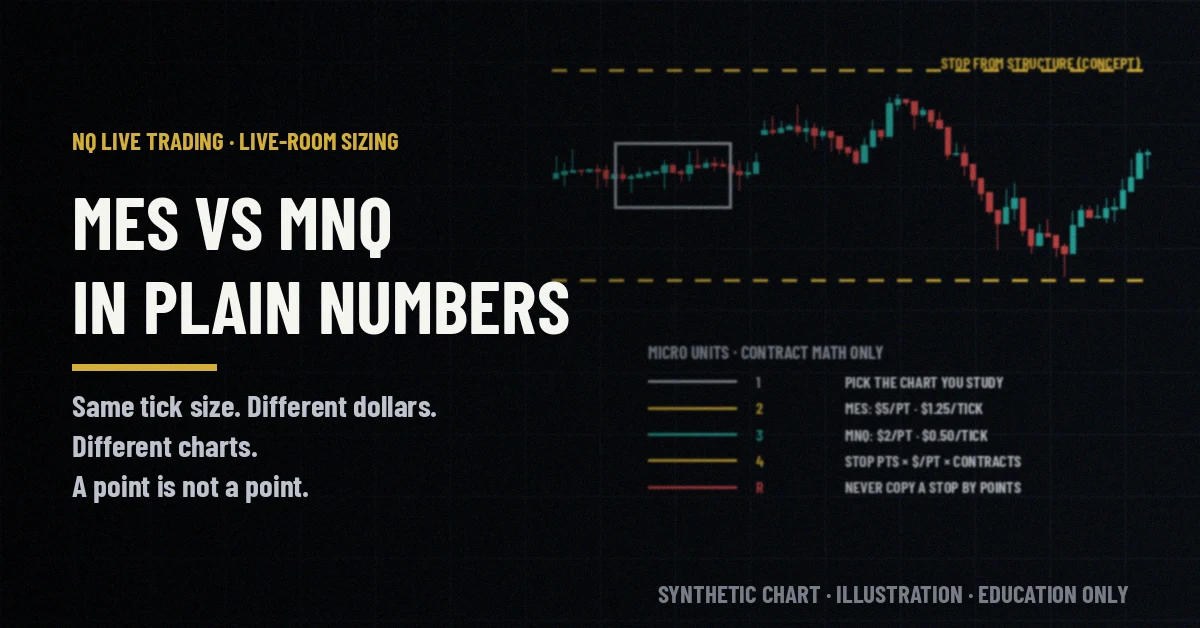
Short answer: MES and MNQ are both CME micro futures, but they track different indexes. MES is $5 times the S&P 500 Index, so one point is $5 and one 0.25-point tick is $1.25. MNQ is $2 times the Nasdaq-100 Index, so one point is $2 and one tick is $0.50. Same tick size, different dollars, different charts.
Education only. Futures trading involves substantial risk of loss. Not financial advice.
Two small contracts, two different markets
You’ve decided to start small. Good. That’s a risk decision, and it’s the right kind of question to ask first.
So you open the contract list and see two “micros” sitting side by side. MES. MNQ. Both small. Both tick in quarter points. Both look like the beginner’s door.
Here’s the part many traders miss. They’re not two sizes of the same thing. They’re two different markets. One follows the S&P 500. The other follows the Nasdaq-100. Their points are worth different dollars, their charts sit at different levels, and a stop that fits one can make no sense on the other.
Let’s put both on the table, in plain numbers, so the choice is a decision instead of a coin flip.
Have you ever done this?
How many traders have watched NQ in a live room, then placed the trade on MES because “it’s smaller,” and wondered why the levels didn’t line up?
How many traders have copied a 20-point stop from one chart to another and never asked what 20 points means on each?
And how many traders have held MES and MNQ at the same time, thinking they’d spread the risk, when both moved the same way at the same moment?
None of that is a character flaw. It’s a units problem. And units are fixable.
What is the difference between MES and MNQ?
MES is the Micro E-mini S&P 500 future. It’s valued at $5 times the S&P 500 Index. MNQ is the Micro E-mini Nasdaq-100 future, valued at $2 times the Nasdaq-100 Index. Both trade in 0.25-point ticks, but they follow different indexes, so they sit at different price levels and move on their own charts.
Here are the CME numbers side by side (CME Group Micro E-mini S&P 500 contract specifications and Rulebook Chapter 353; Micro E-mini Nasdaq-100 contract specifications and Rulebook Chapter 361):
| MES | MNQ | |
|---|---|---|
| Full name | Micro E-mini S&P 500 | Micro E-mini Nasdaq-100 |
| Index it follows | S&P 500 (about 500 stocks) | Nasdaq-100 (about 100 stocks) |
| Contract size | $5 × the index | $2 × the index |
| Minimum tick | 0.25 index points | 0.25 index points |
| One tick is worth | $1.25 | $0.50 |
| One point is worth | $5 | $2 |
| Its bigger sibling | ES (E-mini S&P 500) | NQ (E-mini Nasdaq-100) |
Four ticks make one point on both. That’s where the sameness ends. One MES tick is worth two and a half MNQ ticks.
If you want the NQ side of this in more depth, CK Trader Pro’s how much is one point on NQ and MNQ walks through it, and the NQ futures contract specs page has the full NQ spec sheet.
How much is one point and one tick on MES and MNQ?
One point on MES is $5 per contract. One point on MNQ is $2 per contract. One tick (0.25 points) is $1.25 on MES and $0.50 on MNQ. Multiply by the number of points and the number of contracts to get the dollar move.
Hypothetical contract math only. It doesn’t include commissions or fees.
| Hypothetical move | MES, 1 contract | MNQ, 1 contract | MES, 3 contracts | MNQ, 3 contracts |
|---|---|---|---|---|
| 1 tick (0.25 pt) | $1.25 | $0.50 | $3.75 | $1.50 |
| 1 point | $5 | $2 | $15 | $6 |
| 10 points | $50 | $20 | $150 | $60 |
| 25 points | $125 | $50 | $375 | $150 |
Want to check the MNQ column, or run NQ the same way? Use the NQ tick value calculator. For more on quarter-point ticks, read Quarter-Point Moves: Reading NQ’s Tick Size.
Here’s the big idea
A point is not a point.
A point on MES and a point on MNQ are different dollars on different charts. Before you compare stops, targets or “how far it moved,” convert to dollars per contract. Then compare.
Why doesn’t the same stop mean the same thing on MES and MNQ?
Because the two indexes sit at different levels and each point is worth a different amount. A 20-point stop is $100 on one MES contract and $40 on one MNQ contract. It’s also a different share of each index, so the same point count can be roomy on one chart and tight on the other.
Here’s a hypothetical. Say the S&P 500 is at 6,000 and the Nasdaq-100 is at 20,000. Those are round hypothetical levels, not current prices.
| Hypothetical | MES | MNQ |
|---|---|---|
| Hypothetical index level | 6,000 | 20,000 |
| Notional contract value (level × multiplier) | $30,000 | $40,000 |
| 20-point stop, 1 contract | $100 | $40 |
| 20 points as a share of the level | about 0.33% | 0.10% |
| A 1% move, in points | 60 points | 200 points |
| A 1% move, 1 contract | $300 | $400 |
Look at the last two rows. A 1% move is 60 points on the hypothetical MES and 200 points on the hypothetical MNQ. So if you carry a 20-point stop from MES over to MNQ, you’ve brought a much tighter stop to a chart that counts in bigger point steps. That’s why we never copy a stop by its point count. We set it from the structure on the chart we’re actually trading.
Stops are not guaranteed to fill at your price, and no stop guarantees a maximum loss. A stop-market order becomes a market order when it’s triggered and can fill worse in a fast market. A stop-limit order may not fill at all if price jumps past your limit. Our post on NQ slippage in plain numbers shows what one tick of a worse fill costs.
Is MES or MNQ better for beginners?
Neither one is “the beginner contract.” Both are smaller units of a real, leveraged market, and losses on micros are real money. The better question is which chart you’ll actually study, and whether your stop on that chart, times its dollars per point, fits the risk you planned.
“Micro” means a smaller unit. It doesn’t mean a calmer market, an easier market or a practice market. You can still lose more than you planned, and you still need margin in the account. Margin is set by the exchange and your broker and changes over time; CK Trader Pro’s futures margin requirements page explains how it works.
In my experience, the choice gets simpler when you ask these three questions:
- Which chart do you study every day? If you study NQ, MNQ is the same Nasdaq-100 chart in a smaller unit. MES is a different chart.
- What does your stop cost on that contract? Stop points × dollars per point × contracts. If it doesn’t fit your planned risk, the answer is fewer contracts or no trade.
- Can you name the tick value without looking? $1.25 on MES. $0.50 on MNQ. If you can’t say it, you’re not ready to size it.
How do we handle micros in the live room?
Our room marks levels on the NQ chart. If you trade MNQ, you’re looking at the same Nasdaq-100 levels we mark, in a smaller unit. If you trade MES, our levels don’t transfer point for point, so you’d mark your own on the S&P 500 chart. Either way, size comes from your stop, not from ours.
Here’s how sizing questions usually come up during the 9:30 to 10:30 AM ET session, and how we talk through them:
- “Should I be on MES or MNQ?” We don’t pick a contract for you. We ask which chart you’ve studied and what your stop costs on it.
- “How many micros equal one mini?” On the Nasdaq side, MNQ’s $2 per point is one-tenth of NQ’s $20 per point, so ten MNQ carry the point value of one NQ. Our NQ vs MNQ sizing post covers that comparison and the size-from-the-stop formula.
- “Can I hold MES and MNQ together?” In my experience, the two often move in the same direction on broad market days, though not always and not by the same amount. Holding both can be closer to doubling one idea than spreading it. Count the combined dollar risk.
- “What’s a tick worth again?” We say it out loud: $1.25 MES, $0.50 MNQ. Our NQ tick value post has the NQ side.
- “How many contracts for my account size?” That’s your risk plan, not a room call. Our post on how many MNQ contracts for a 50k account shows the drawdown math.
What don’t we do?
We don’t call trades, pick contracts for people or treat micros as “free practice.” We don’t copy stops by point count from one chart to another. And we don’t size a micro trade so tight that one tick of a worse fill breaks the plan.
- No “MES is safer” or “MNQ is easier.” Neither claim holds.
- No borrowing levels from one index for the other.
- No stacking both micros and calling it diversification without counting the dollars.
Here’s the point
MES and MNQ are both small, and both tick in quarter points. But a point on MES is $5 and a point on MNQ is $2, and they sit on different charts. Convert every stop to dollars per contract, set it from the chart you’re trading, and size from there. That’s the whole job.
Remember this
Same tick size. Different dollars. Different charts.
So here’s my question: on the micro you’re watching right now, what does your usual stop cost on one contract?
Questions on size? Bring them live
Questions on size? Bring them live. We meet Monday through Friday, 9:30 to 10:30 AM ET, and we talk through levels, stops and sizing on the NQ chart as the open forms. Bring your MES or MNQ questions. There’s no cost to attend. Join the free live room. New here? Read how the free live room works.
Registration is required. Adults 21+. Sessions are education, not signals.
The room is the free education arm of CK Trader Pro.
Join the Academy
Want the structure behind the morning? CK Trader Pro is futures and prop firm education: step-by-step lessons, live sessions and risk planning. It’s the CK Trader Pro Membership, which includes:
- Members-only educational lessons on prop-firm rules, drawdown, daily loss limits, position sizing and risk
- War Room: CK’s live pre-market planning session, weekdays 8:30–9:30 AM ET, where the day’s risk and news times get written down before the open
- CK’s chart setup, shown and explained live in every session
- Economic news calendar
Education only. No trade signals or personal advice. No results promised.
Billed monthly until you cancel. See pricing at cktraderpro.com.
The live room stays free either way.
FAQ
What is the difference between MES and MNQ? MES is the Micro E-mini S&P 500 future, valued at $5 times the S&P 500 Index. MNQ is the Micro E-mini Nasdaq-100 future, valued at $2 times the Nasdaq-100 Index. Both trade in 0.25-point ticks, but they follow different indexes and move on their own charts.
How much is one point and one tick on MES and MNQ? One point is $5 on one MES contract and $2 on one MNQ contract. One 0.25-point tick is $1.25 on MES and $0.50 on MNQ, per CME’s contract specifications.
Is MES or MNQ better for beginners? Neither is “the beginner contract.” Both are smaller units of a real, leveraged market, and losses are real money. A more useful question is which chart you study and whether your stop on it, times its dollars per point, fits the risk you planned.
Why doesn’t a 20-point stop mean the same thing on MES and MNQ? Each point is worth a different amount and the two indexes sit at different levels. A 20-point stop is $100 on one MES and $40 on one MNQ, and it’s a different share of each index. Set stops from the chart you’re trading, not by point count.
Can I trade MES and MNQ at the same time? You can. In our experience, they often move in the same direction on broad market days, though not always and not by the same amount. Holding both can add up to more risk on one idea than you planned, so count the combined dollar risk.
Do stops guarantee my maximum loss on micros? No. Stops are not guaranteed to fill at your price, and no stop guarantees a maximum loss. A stop-market order can fill past your stop in a fast market, and a stop-limit may not fill at all.
About CK
CK (George Ama) is a futures trader since 1998 and the founder of CK Trader Pro. He is the author of The Risk First Series, including Risk First: The NQ Futures Playbook and Risk First: Execution.
Trading futures involves substantial risk of loss and is not suitable for everyone. Past performance is not indicative of future results. Education only, not financial advice. The live room is for adults 21+. Example numbers in this article, including index levels, are hypothetical contract math, not current prices, predictions or recommendations, and don’t include commissions or fees. No stop guarantees a maximum loss; stops are not guaranteed to fill at your price. CK Trader Pro and NQ Live Trading aren’t owned, run or endorsed by any prop firm or exchange. See our Risk Disclosure, CK Trader Pro’s Risk Disclosure and Disclosures. NQ Live Trading and CK Trader Pro are operated by CK TRADING INSTITUTE OF TECHNOLOGY LLC.