
What Moves NQ Futures? The Nasdaq-100 in Plain English
By CK · Futures trader since 1998
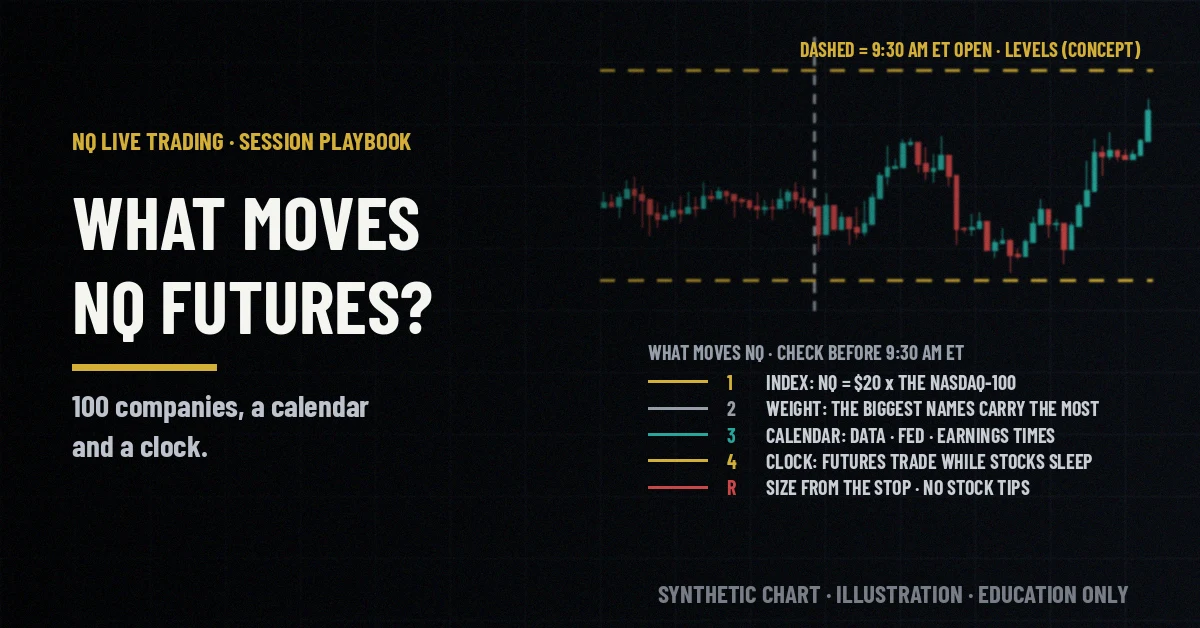
Short answer: NQ futures track the Nasdaq-100 index. CME defines the contract as $20 times the index. So what moves NQ is what moves the Nasdaq-100: the prices of its biggest companies, scheduled news like inflation, jobs and Fed decisions, company earnings, and anything that happens while the stock market is closed, because NQ trades nearly around the clock. We don’t predict any of it. We learn what’s in the index, know what’s on the calendar, and let the 9:30 AM ET open show us what’s actually moving.
Education only. Futures trading involves substantial risk of loss. Not financial advice.
The chart that moves while you sleep
It’s 7:45 in the morning. You open your NQ chart and it’s already 80 points from where you left it.
No news on your screen. No idea why. You check social media and get ten different answers. One person blames a chip company. Another blames bonds. A third says “the algos.”
So you trade the open anyway. And you’re not trading a plan. You’re trading a mystery.
I’ve been there. Early on I watched the chart and never asked what was underneath it. Here’s what I learned: NQ isn’t a mystery. It’s 100 companies, a calendar and a clock.
So let’s take the mystery out of it.
Have you ever done this?
How many traders have traded NQ for months without being able to name what’s inside it?
How many traders have been surprised by a big overnight move that was on a public schedule the whole time?
And how many traders have taken a trade because “tech is hot today,” without a level, a stop or a size?
None of those are market problems. They’re preparation problems. And preparation is something you control.
What is NQ futures, in plain English?
NQ is the E-mini Nasdaq-100 futures contract, listed by CME Group. Per CME’s contract specs, one NQ contract is $20 times the Nasdaq-100 index, with a minimum tick of 0.25 index points. MNQ, the Micro, is $2 times the index. When the index moves one point, one NQ contract moves $20.
The Nasdaq-100 itself is built by Nasdaq. Its methodology says it’s designed to measure 100 of the largest Nasdaq-listed non-financial companies, using a modified market-capitalization weighting. In my course I put it simply: companies with a larger market value have more influence on how the index moves.
You’ll notice the fact sheet counts 101 securities, not 100. Nasdaq’s methodology lets more than one share class of the same company be in the index. Alphabet, for example, has two: Class A (GOOGL) and Class C (GOOG).
If you want the full contract breakdown (tick size, months, settlement), CK Trader Pro’s NQ futures contract specs guide covers it. This post is about what moves it.
What are the Nasdaq-100’s top holdings?
Per Nasdaq’s NDX fact sheet, all information as of September 30, 2026, the ten largest components by weight added up to about 46.9% of the index. NVIDIA was the largest at 8.36%, then Apple at 7.38% and Microsoft at 5.78%. These weights change every day with prices and at each rebalance, so treat them as a dated snapshot, not today’s number.
| # | Company (ticker) | Weight, as of Sep 30, 2026 |
|---|---|---|
| 1 | NVIDIA (NVDA) | 8.36% |
| 2 | Apple (AAPL) | 7.38% |
| 3 | Microsoft (MSFT) | 5.78% |
| 4 | Micron Technology (MU) | 5.04% |
| 5 | Advanced Micro Devices (AMD) | 4.19% |
| 6 | Amazon.com (AMZN) | 4.08% |
| 7 | Meta Platforms (META) | 3.27% |
| 8 | Alphabet Class A (GOOGL) | 3.07% |
| 9 | Alphabet Class C (GOOG) | 2.86% |
| 10 | Tesla (TSLA) | 2.83% |
Source: Nasdaq, Nasdaq-100 Index fact sheet (“All Information as of 09/30/2026”; retrieved November 20, 2026 ET). The same fact sheet shows the Technology industry at 68.01% of the index weight across 47 securities. For the current component list, see Nasdaq’s Nasdaq-100 index page.
This is not a list of stocks to buy or sell. It’s a map of where the weight sits. That’s all we use it for.
Why do a few big stocks move NQ so much?
Because the index is weighted by modified market value, a 1% move in a company with a large weight moves the index more than a 1% move in a company with a small weight. When roughly half the index weight sits in ten names, as it did on September 30, 2026, those names carry a lot of the day’s story.
Think of it like a seesaw with 100 kids on it, where a few of them are much heavier than the rest. When one of the heavy kids moves, the whole board tilts.
Nasdaq does put limits on how heavy any one company can get. Its methodology caps single-company weights and the combined weight of the largest names at the annual reconstitution and the quarterly rebalances. But inside those limits, the biggest companies still carry the most weight.
In my experience, this is one of the first things I want a new NQ trader to learn: when NQ moves hard and you don’t know why, look at the heaviest names first. Not to trade them. To understand the chart in front of you.
Here’s the big idea
NQ isn’t a mystery. It’s 100 companies, a calendar and a clock.
The companies tell you where the weight is. The calendar tells you when news is scheduled. The clock tells you when the stocks are trading and when only the futures are.
What news moves NQ futures?
CME’s own NQ product page lists the kinds of reports and events that move markets: the monthly jobs report, company earnings updates, the Consumer Price Index, central bank operations, unemployment data, Federal Open Market Committee decisions, industrial production and energy supply reports. Many of these are scheduled ahead of time, so you can know the time before you know the number.
Here’s how we sort them:
| What moves NQ | Scheduled? | What we do before the open |
|---|---|---|
| Economic data (CPI, jobs report, unemployment) | Yes, on public calendars, often at 8:30 AM ET | Write the release time on the card. No trades into the number. |
| Fed decisions (FOMC) | Yes, published in advance | Know the statement and press-conference times. |
| Earnings from the heaviest companies | Yes, companies announce dates | Know which big names report this week, and whether before the open or after the close. |
| Overnight and global news | No | Read where NQ is versus the prior-day and overnight levels. |
| Index changes (rebalance, reconstitution) | Yes, Nasdaq publishes the schedule | Know the effective date. It’s information, not a direction. |
Source for the first column: CME Group’s E-mini Nasdaq-100 page (“Key economic reports and factors that move markets”). Index schedule: Nasdaq’s Nasdaq-100 methodology.
In my course I also teach that tech valuations are sensitive to interest-rate expectations. That’s why inflation data and Fed days get so much attention from NQ traders. Our posts on NQ on CPI mornings, jobs-report Fridays and trading NQ on FOMC day cover each one. And our guide on how to use the economic calendar before trading NQ shows how we check the week.
Why does NQ move before the stock market opens?
Because NQ futures trade nearly 24 hours a day on CME Globex, Sunday through Friday, 6:00 PM to 5:00 PM ET, with a daily break from 5:00 to 6:00 PM ET. The Nasdaq-100 index itself is calculated from the stocks’ prices, and Nasdaq disseminates it from 9:30:01 AM to 5:16 PM ET. So overnight and before 9:30, the futures are pricing news while the regular stock session is closed.
That’s why an earnings report after the close or a headline at 3 AM can show up on your NQ chart long before the stocks open. The futures move first. Then at 9:30 AM ET, the U.S. stock market opens and the index stocks start trading in the regular session.
Remember: 9:30 AM ET is the U.S. stock market open, not the CME open. NQ has been trading since the prior evening.
In my experience, many traders treat the overnight move as the day’s direction. We treat it as a map. Where is NQ sitting versus yesterday’s high and low, and versus the overnight high and low? Our simple pre-market plan for NQ walks through the order we mark them.
When does the Nasdaq-100 change what’s in it?
Per Nasdaq’s methodology, the index is reconstituted once a year in December and rebalanced in March, June and September. Changes take effect at the market open on the first trading day after the third Friday of those months. For December 2026, the third Friday is December 18, so under that rule the reconstitution should take effect at the open on Monday, December 21, 2026. That date is worked out from the rule, not one Nasdaq has announced yet.
Nasdaq ranks companies using data as of the last trading day of November and announces the changes ahead of the effective date. Watch Nasdaq’s index page for the announcement. Companies can be added or removed, and weights can be reset.
What does that mean for an NQ trader? Two things. First, the weights in the table above are a snapshot and will change. Second, an index change is a scheduled event. In my experience, it’s something to know about, not something to guess the direction of.
How much does an index move cost on NQ?
Every point the Nasdaq-100 moves is a point on NQ. On NQ, a point is $20 and a tick (0.25 points) is $5. On MNQ, a point is $2 and a tick is $0.50. So a move that looks small on the index can be a lot of dollars on one NQ contract.
Here’s a hypothetical example, not a recommendation or a prediction:
| Hypothetical move | Ticks | One NQ contract | One MNQ contract |
|---|---|---|---|
| 10 points | 40 | $200 | $20 |
| 25 points | 100 | $500 | $50 |
| 50 points | 200 | $1,000 | $100 |
NQ is $20 per point with a 0.25-point tick worth $5, per CME’s E-mini Nasdaq-100 contract specs, and MNQ is $2 per point and $0.50 per tick, per CME’s Micro E-mini Nasdaq-100 contract specs. These moves are hypothetical. They don’t include commissions, fees or slippage. If a news morning needs a wider stop than your planned risk allows on NQ, you trade MNQ, trade fewer contracts or pass. Run your own numbers in the NQ tick value calculator.
Stops are not guaranteed to fill at your price, and no stop guarantees a maximum loss. A stop-market order becomes a market order when it’s triggered and can fill worse in a fast market. A stop-limit order may not fill at all if price jumps past your limit.
How do we read what’s moving NQ before the open?
We don’t guess. We run the same short routine every morning: check the calendar, check which big names reported, mark the levels, and let the 9:30 AM ET open show us what’s actually moving. Then we size from the stop.
Here’s the checklist I use:
- Check the news times. Any 8:30 AM ET data? A Fed day? Write the times down.
- Check the heavy names. Did any of the largest index companies report earnings after yesterday’s close or before today’s open? You don’t need an opinion on the stock. You need to know why NQ might already be moving.
- Read the overnight session. Where is NQ versus the prior-day high and low and the overnight high and low?
- Let the open talk first. At 9:30 AM ET the index stocks open in the regular session. The first candle is information, not a plan.
- Size from the stop. If the morning needs more stop room, the size comes down. Never the other way around.
- Cap the trade count. A busy news day is not a reason to take more trades.
If you’re newer to futures and want the foundations first, CK Trader Pro’s futures trading education hub lays them out step by step.
How do we handle it in the live room?
At the open we say out loud what’s on the calendar and what’s already moved overnight, mark the levels on the NQ chart, and talk through what price is doing as the stocks start trading. We don’t call trades, we don’t give stock picks, and we don’t tell anyone where to put orders.
Here’s how it usually sounds during the 9:30 to 10:30 AM ET session:
- The news line. What’s scheduled today, and what already happened overnight.
- The map. Prior-day high and low, overnight high and low.
- Hands off the first move. Note the speed and which level got hit.
What don’t we do?
We don’t trade a headline. We don’t predict what a company’s earnings will do to NQ. And we don’t turn a holdings list into a stock tip.
- No stock picks, from the top 10 or anywhere else.
- No predictions about earnings, data or Fed days.
- No statistics without a published source and a date.
- No bigger size because “tech is moving today.”
Here’s the point
NQ looks wild when you don’t know what’s underneath it. It isn’t. It’s the Nasdaq-100: a weighted basket of 100 of the largest Nasdaq-listed non-financial companies, where the biggest names carry the most weight. It reacts to scheduled news, company earnings and overnight headlines, and it trades while the stocks sleep. Your job doesn’t change: know what’s in it, know what’s on the calendar, mark the map, let the open talk first and size from the stop.
Remember this
Know what’s under the chart. Then trade your plan, not the noise.
So here’s my question: the last time NQ moved before the open, did you know why, or did you just react?
See what’s moving at the open
See what’s moving at the open. We meet Monday through Friday, 9:30 to 10:30 AM ET. We say what’s on the calendar, mark the levels and walk through the open out loud on the NQ chart. Bring your news times and your risk card. There’s no cost to attend. Join the free live room. New here? Read how the free live room works.
Registration is required. Adults 21+. Sessions are education, not signals.
The room is the free education arm of CK Trader Pro.
Join the Academy
Want the structure behind the morning? CK Trader Pro is futures and prop firm education: step-by-step lessons, live sessions and risk planning. It’s the CK Trader Pro Membership, which includes:
- Members-only educational lessons on prop-firm rules, drawdown, daily loss limits, position sizing and risk
- War Room: CK’s live pre-market planning session, weekdays 8:30–9:30 AM ET, where the day’s risk and news times get written down before the open
- CK’s chart setup, shown and explained live in every session
- Economic news calendar
Education only. No trade signals or personal advice. No results promised.
Billed monthly until you cancel. See pricing at cktraderpro.com.
The live room stays free either way.
FAQ
What moves NQ futures? NQ tracks the Nasdaq-100 index, so it moves with the index’s stocks, especially the largest by weight. Scheduled news (inflation data, the jobs report, Fed decisions), company earnings and overnight headlines can all move it. Because NQ trades nearly 24 hours on CME Globex, it can move while the stock market is closed.
What is NQ futures? NQ is CME Group’s E-mini Nasdaq-100 futures contract. Per CME, it’s $20 times the Nasdaq-100 index, with a minimum tick of 0.25 index points ($5). The Micro version, MNQ, is $2 times the index ($0.50 per tick).
What are the Nasdaq-100’s top holdings? Per Nasdaq’s NDX fact sheet as of September 30, 2026, the top three by weight were NVIDIA (8.36%), Apple (7.38%) and Microsoft (5.78%), and the top ten added up to about 46.9% of the index. Weights change daily with prices and at each rebalance; check Nasdaq’s index page for current data. This is not a recommendation to buy or sell any stock.
Why does NQ move before 9:30 AM ET? NQ futures trade Sunday through Friday, 6:00 PM to 5:00 PM ET, with a daily 5:00 to 6:00 PM ET break. The index stocks trade in the regular session from 9:30 AM ET. So overnight news and earnings released outside regular hours can move NQ before the stocks open.
When does the Nasdaq-100 rebalance? Per Nasdaq’s methodology, it’s reconstituted every December and rebalanced in March, June and September, effective at the open on the first trading day after the third Friday of those months. Under that rule, the December 2026 reconstitution should take effect at the open on Monday, December 21, 2026. That date is worked out from the rule, so check Nasdaq’s announcement.
Can I predict NQ from the top stocks? We don’t, and we don’t give stock tips. Knowing where the index weight sits helps you understand why NQ is moving. It doesn’t tell you where it goes next. We plan the open the same way every day and size from the stop. Stops are not guaranteed to fill at your price, and no stop guarantees a maximum loss.
About CK
CK (George Ama) is a futures trader since 1998 and the founder of CK Trader Pro. He began as a quant analyst and started trading in the pits in 2000 before moving to the screen. Today he teaches risk-first futures education in a free live room every weekday at 9:30 AM ET.
Trading futures involves substantial risk of loss and is not suitable for everyone. Past performance is not indicative of future results. Education only, not financial advice. The live room is for adults 21+. Example numbers in this article, including point moves and dollar amounts, are hypothetical contract math, not current prices, predictions or recommendations, and don’t include commissions, fees or slippage. Nasdaq-100 holdings and weights are from Nasdaq’s NDX fact sheet as of September 30, 2026; index rules are from Nasdaq’s Nasdaq-100 methodology, and contract specs and trading hours are from CME Group, as of November 20, 2026. They change; check the source before you rely on them. Company names are shown only to describe the index; nothing here is a recommendation to buy or sell any security. No stop guarantees a maximum loss; stops are not guaranteed to fill at your price. CK Trader Pro and NQ Live Trading aren’t owned, run or endorsed by any prop firm, exchange or index provider. See our Risk Disclosure, CK Trader Pro’s Risk Disclosure and Disclosures. NQ Live Trading and CK Trader Pro are operated by CK TRADING INSTITUTE OF TECHNOLOGY LLC.